






A cross-industry collaboration in California’s wine country has launched a closed-loop recycling program for used plastic stretch film, with an aim to provide a replicable framework for other regions, industries and hard-to-recycle materials.
A common challenge for most stretch film users – including agricultural films and pallet wrap from retailers – is that while they amass considerable volumes, they still are not enough to justify regular collection and transport. And most MRFs do not accept film, which quickly gums up sorting machinery.
“The biggest industry problem of collecting film is how to aggregate it,” Mark Huber, president of business development at recycler iSustain, told Plastics Recycling News. “We’re always looking for film, but we try to find sources that are able to aggregate. The grocery chains do a really good job, but small manufacturing has a really big opportunity to move the needle.”
After a breakout session at the RISE Climate and Wine Symposium revealed this was a shared issue rather than an individual one, a group of industry stakeholders formed the North Bay Zero Waste Collective, which now leads the initiative. Partners include Sigma Stretch Film, recycler iSustain and polyolefins reclaimer Polyfit.
“This was a grassroots program, not some recycler going to one company and convincing them to do something,” Huber said.
Before discovering Sigma’s stretch film processes, the wineries in the Napa and Sonoma valleys had begun aggregating their stretch film and sending it into plastic lumber production, Huber said.
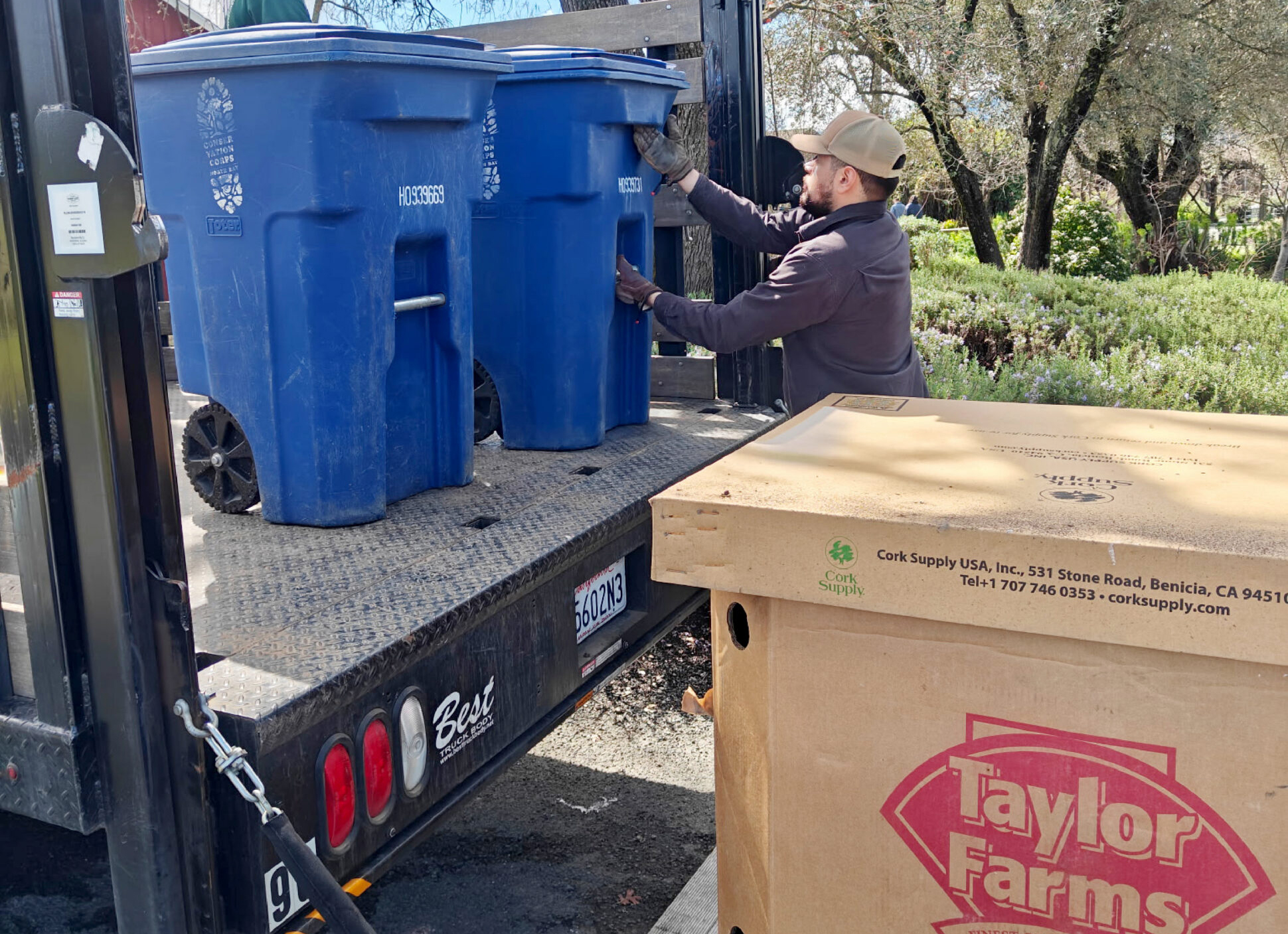
Conservation Corps North Bay and Wine Service Co-op collect, aggregate and bale film from more than 100 wineries and businesses. When enough film is collected for a full truckload, it is processed by iSustain and pelletized by Polyfit in Mexico, then used to make Sustain360 stretch film.
The program is expected to collect 20 to 30 truckloads a year, each containing about 40,000 pounds of used plastic film. In addition to keeping film out of landfills, the program avoids landfill fees for the participating businesses.
In the past iSustain has coordinated aggregations of film bales among nearby businesses, in what Huber called “milk runs.” “If businesses can pool their waste streams together, then all of a sudden you make the logistics feasible for recycling companies to aggregate and collect and pick up,” Huber said.
Part of the unique nature of the California collaboration is that competing companies pull together for the greater good, he said.
St. Supéry Estate Vineyards & Winery in Rutherford, California, worked with iSustain and Sigma to determine how to recover and convert used stretch film into PCR resin, then use it in new rolls of Sustain360 stretch film. In the program’s first year, the winery collected 5,200 pounds of film.
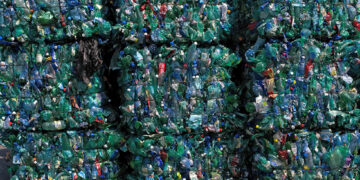
iSustain pays market value for the clear stretch film the collective pulls together. The almost entirely clear bales – known as A-grade LDPE/LLDPE – are priced at a premium, higher by 9-10 cents/lb than B-grade bales in March, according to RecyclingMarkets.Net data.
Shoring up domestic supply
The feedstock film is collected in California, then processed and remanufactured in the US and Mexico, providing a realistic pathway for material to return to the same company that put it in the recycling stream, the collective said.
Amid geopolitical instability and current US policy moves that have disrupted supply chains, reshoring or nearshoring manufacturing has resurfaced in recent months. And as recent events in RPET markets have shown, domestic supply sourcing can help reduce pricing volatility and support domestic recyclers.
“A closed loop is not achievable with offshore manufacturing,” the group said in a case study about the California project.
“Rather than replacing an effective material with heavier or more resource-intensive alternatives, this approach improves what already works,” the collective added.
And while much attention has focused on brands pulling back on their sustainability commitments, Huber recently experienced a first in a request for quotation (RFQ) from a major global customer of a distribution company.
To bid on the project to supply stretch film, the distributor needed to include a sustainable circularity plant. “To me, that is a sign of change, because I’ve never seen that before, where to supply a product you had to have a sustainability plan associated with it,” Huber said. “It was moving beyond the feel-good. It was: How are you going to take our waste away as well as provide us a product?”