






Resource Recycling
  • The Latest
  • Analysis
    • All
    • Certification Scorecard
    • Industry Announcements
    • Opinion
    NJ’s PCR delay risks making its own excuse permanently true

    NJ’s PCR delay risks making its own excuse permanently true

    E-scrap magnet recycling company scales up

    Why only some rare-earth sources are economically viable

    e-Stewards to develop an ITAD-specific standard

    Certification scorecard — week of Sept. 21

    Who should pay for lithium-ion battery fire damage?

    America’s critical-materials buildout has a feedstock problem

    Certification scorecard – week of Sept. 14

  • Conferences
    • Resource Recycling Conference
    • Plastics Recycling Conference
    • E-Scrap: The Longevity Conference
    • Textiles Recovery Summit
  • Publications
    • E-Scrap News
    • Plastics Recycling Update
    • Policy Now
    • Resource Recycling
    • Other Topics
      • All Topics
      • Brand Owners
      • Critical Minerals
      • Glass
      • Grant Watch / RFPs
      • Markets
      • Organics
      • Packaging
      • Research
      • Technology
      • Textiles
Subscribe
No Result
View All Result
Resource Recycling
No Result
View All Result
Home Plastics

Trex gears up for new plastic board plant

Antoinette SmithbyAntoinette Smith
March 24, 2026
in Plastics
Closeup of Trex composite flooring installed in a restaurant.

Photo courtesy of Trex

Trex is preparing to start up for its new composite decking production facility in Arkansas, an executive said during an interview, as the company works toward vertical integration in its supply chain. 

Amy Fernandez, chief sustainability officer at Virginia-based Trex, said the company is completing the Little Rock facility, and “we’re still working through when we actually want to do the startup.” She added that a couple plastics processing lines are already running, and the company has the “capacity to run a lot more lines there, but we don’t need it yet.” 

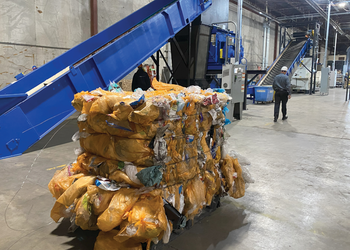
The three-year downturn in global consumer demand has not spared Trex, whose products rely on the construction and remodeling sector. However, “demand hasn’t dropped to the point where we’ve had to really take any drastic measures,” instead taking advantage of the company’s considerable warehouse storage space across the US to store film bales rather than ceasing buying altogether.

That extended slump in end-user demand has hit recyclers across all sectors, including the sudden shuttering of WM’s Natura PCR plant in Texas last fall. 

Ensuring consistent supply is among several reasons Trex and other companies are moving toward vertical integration. Buying smaller companies or developing their own supply chains also can help improve costs and streamline logistics. Other examples include LyondellBasell and ExxonMobil’s investment in the Cyclyx pre-processing facility in Texas, and PureCycle’s construction of a secondary sorting operation to feed its polypropylene dissolution recycling plant.

Trex has been producing its own LDPE pellets since 2024, when it started up the processing lines at the Arkansas site. The company had been using the recycled resin at its Virginia and Nevada board-production facilities, reducing its dependence on third-party suppliers. The pellets will now be used at the new production lines as well. 

Fernandez added, “In the past we couldn’t meet all of our own demand, and so we did have to buy some pellets outside of Trex. We want to manufacture all of our raw materials.” 

Expanding feedstock slate helps lower costs

Trex develops its own equipment, Fernandez told Plastics Recycling Update. “We don’t buy off-the-shelf equipment, which is what helps us process a broader range of material. And we’re always trying to improve our costs for our products.” 

The bespoke equipment allows Trex to accept a wide range of LDPE film, with increasing levels of contamination being acceptable as sorting processes advance, she said. The company can process C-grade LDPE film bales, with up to 25% contamination depending on the foreign material. For example, 25% paper fiber may be acceptable but 25% metal would not be, she said. 

Using lower-grade bales can make a significant difference in costs. In March, LDPE A-grade film bales (containing 95-99% clear film) were at a national average of 13.50 cents/lb, versus 5.25 cents/lb for B-grade (around 80% clear film) and -0.56 cents/lb for C-grade, according to RecyclingMarkets.Net data. 

And of course, the new plant’s location was strategic, to provide access to feedstock sources in the central part of the country, Fernandez said. To help enable feedstock collection, Trex also provides balers for supply partners, and when they amass enough material for a truckload, Trex sends one of its large fleet of trailers to pick it up. The company also has numerous warehouses across the US, to optimize regional logistics. 

“We have really long-standing relationships with the companies we source from,” she said. Although long-term contracts are not yet a part of the procurement strategy, Trex typically establishes one- or two-year agreements that are renewed repeatedly, she said. 

Value chain partners include Ohio’s ScottsMiracle-Gro, which diverts plastic film scrap from its soil bag production, into the NexTrex program. 

“For the companies that want to be able to say that they recycle or that their bags are recyclable, they are looking to try to partner with us to be able to put that NexTrex mark on their bag, and then to be able to assist us to get them because if they do get into that collection bin, it gets to us.” 

And while single-use bag bans have become popular, Trex’s reliance on post-consumer bags is minimal, so the company has felt minimal effects, Fernandez said. Even so, the company maintains a film drop-off directory, and uses post-consumer plastic bags as an opportunity to educate the public about recycling. 

Initiatives include collection bins placed at universities and retirement communities, and extended producer responsibility (EPR) laws have spurred bag makers to seek out the NexTrex commercial recycling program to source EPR-compliant shopping bags, she said. 

Aside from used shopping bags, the company can adapt to unusual feedstocks, including rolls of off-spec commercial stretch wrap. For those, the engineering team had to design equipment to cut through giant rolls of blue film, and devised a solution for processing and incorporating the material, she said.  “We’re constantly reaching out to various companies and industries to try and figure out what we can take and how we’re going to process it.”


Tags: Film & Flexibles
TweetShare
Antoinette Smith

Antoinette Smith

Antoinette Smith has covered commodity plastics and supply chains for more than a decade, with a special focus on economic impacts and consumer behavior. She brings a balanced, thoughtful view to recycling stories, and isn't afraid to ask "why?" Contact Antoinette at antoinette@dev.resource-recycling.com.

Related Posts

trash bags

Sorted: Should we use recycled trash bags?

byBrian Clark Howard
September 28, 2026

Manufacturers’ resistance is rooted in performance and cost, but the products may have an important role to play.

SB 54 plan for cartons, film draws warning

byStefanie Valentic
September 15, 2026

The new law's cartons and film targets could add 100,000 tons of plastic contamination to California's paper exports annually, a...

SB 54 Unpacked: Can film catch up to cartons?

byStefanie Valentic
September 4, 2026

Flexible film, generating 550,000 tons/year of waste, has end markets for only about 10% of it, panelists said at a...

Canada seeks recycled-content mandates feedback

Building demand for recycled flexibles

byBrian Clark Howard
August 25, 2026

A new report from Delterra and Eunomia found that companies could readily create demand for up to 800,000 tons of...

Hefty ending Orange Bag program

Hefty ending Orange Bag program

byAntoinette Smith
August 25, 2026

Although the Hefty ReNew program is ending, an Omaha recycler will continue accepting the bags as feedstock for plastic lumber.

Two pilot programs in CA recycle commercial film

byIsabella Burke
August 10, 2026

Two new pilot programs are testing different approaches to collecting and recycling commercial plastic film.

Load More
Next Post
ag plastics field

Ag industry holds potential for recycling feedstock

2026 Buyers’ Guide

Equipment, services and technology suppliers serving the recycling industry.

Browse the Guide

More Posts

Apple store

Apple leads on inputs, faces questions on ITAD

May 1, 2026
Data erasure firm expands wearable device capabilities

Apple hits 30% recycled content, debuts new recovery tech

April 17, 2026
Ten e-scrap projects receive federal prize funds

Recycling rates for rare earths could double by 2040

July 17, 2026
Closeup of a printed circuitboard

Hardware demand puts new focus on parts harvesting

June 5, 2026

In other news: May 2, 2016

May 2, 2016
Textile EPR and the definition of recycling

Textile Exchange reports progress in production

September 22, 2026

AI and the changing economics of retired hardware

June 12, 2026

Who should pay for lithium-ion battery fire damage?

September 21, 2026

America’s critical-materials buildout has a feedstock problem

September 18, 2026
Study assesses environmental cost of excess data storage

BAN paper says AI e-scrap estimates are low

September 17, 2026
Load More

About & Publications

About Us

Staff

Archive

Magazines

Work With Us

Advertise
Jobs
Contact
Terms and Privacy

Newsletters

Get the latest recycling news and analysis delivered to your inbox every week. Stay ahead on industry trends, policy updates, and insights from programs, processors, and innovators.

Subscribe

Welcome Back!

Login to your account below

Forgotten Password?

Retrieve your password

Please enter your username or email address to reset your password.

Log In

Add New Playlist

No Result
View All Result
  • The Latest
  • Analysis
  • Recycling
  • E-Scrap
  • Plastics
  • Policy Now
  • Conferences
    • E-Scrap Conference
    • Plastics Recycling Conference
    • Resource Recycling Conference
    • Textiles Recovery Summit
  • Magazines
  • About Us
  • Advertise
  • Archive
  • Jobs
  • Staff
Subscribe
This website uses cookies. By continuing to use this website you are giving consent to cookies being used. Visit our Privacy and Cookie Policy.