






Resource Recycling
  • The Latest
  • Analysis
    • All
    • Certification Scorecard
    • Industry Announcements
    • Opinion
    MP Materials breaks ground on rare earth magnet campus in North Texas

    How critical mineral alliances aim to shape the future of e-scrap metals

    Certification Scorecard — Week of May 18, 2026

    Aurubis: Thefts involved scrap sample manipulation

    Metals and electronics recyclers report growth

    Plastic packaging

    Why SB 54 source reduction planning is becoming the industry’s most challenging EPR test

    Recycler cites market pressure in short-term closure

    AI, data anxiety push enterprises to destroy working devices: report

    Before the Bin: America’s textile waste problem starts in your closet

  • Conferences
    • Resource Recycling Conference
    • Plastics Recycling Conference
    • E-Scrap: The Longevity Conference
    • Textiles Recovery Summit
  • Publications
    • E-Scrap News
    • Plastics Recycling Update
    • Policy Now
    • Resource Recycling
    • Other Topics
      • Brand Owners
      • Critical Minerals
      • Glass
      • Grant Watch
      • Markets
      • Organics
      • Packaging
      • Research
      • Technology
      • Textiles
      • All Topics
Subscribe
No Result
View All Result
Resource Recycling
  • The Latest
  • Analysis
    • All
    • Certification Scorecard
    • Industry Announcements
    • Opinion
    MP Materials breaks ground on rare earth magnet campus in North Texas

    How critical mineral alliances aim to shape the future of e-scrap metals

    Certification Scorecard — Week of May 18, 2026

    Aurubis: Thefts involved scrap sample manipulation

    Metals and electronics recyclers report growth

    Plastic packaging

    Why SB 54 source reduction planning is becoming the industry’s most challenging EPR test

    Recycler cites market pressure in short-term closure

    AI, data anxiety push enterprises to destroy working devices: report

    Before the Bin: America’s textile waste problem starts in your closet

  • Conferences
    • Resource Recycling Conference
    • Plastics Recycling Conference
    • E-Scrap: The Longevity Conference
    • Textiles Recovery Summit
  • Publications
    • E-Scrap News
    • Plastics Recycling Update
    • Policy Now
    • Resource Recycling
    • Other Topics
      • Brand Owners
      • Critical Minerals
      • Glass
      • Grant Watch
      • Markets
      • Organics
      • Packaging
      • Research
      • Technology
      • Textiles
      • All Topics
Subscribe
No Result
View All Result
Resource Recycling
No Result
View All Result
Home Plastics

Industry descends on DC to fight for PET

Antoinette SmithbyAntoinette Smith
May 13, 2026
in Plastics
Industry descends on DC to fight for PET

Kari Ahlers / Shutterstock

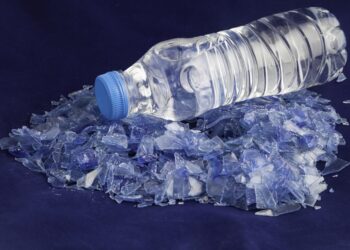
Leaders of the PET Plastic Coalition, a subgroup of the National Association of PET Container Resources (NAPCOR), are in Washington, DC, this week to meet with lawmakers. 

With the Congressional Recycling Caucus among the planned meetings, the coalition will discuss how targeted collection policy and infrastructure could help scale US recycling, as well as explain the nuances between various types of plastic. 

The topic has taken on urgency as the US has lost about 25% of PET recycling capacity over the past 18 months. Seven facilities have shut down amid challenging economic conditions including global overcapacity and cheap imports. 

The first step in gaining lawmaker buy-in would be perhaps the most obvious: ensuring that legislators understand what PET is, and that it is “made to be remade.” 

“Good policy is important but it really starts with educating folks on the merits of PET,” said Laura Stewart, executive director of NAPCOR, during an interview. 

People outside the recycling industry – including legislators – often regard plastics as a homogenous monolith and present one-size solutions, without consideration of the wide array of polymer types, attributes and functions. 

“Plastic is plastic” to many laypeople, said Byron Geiger, head of operations with Indorama Ventures Sustainable Solutions, during the same interview, before he and the coalition went to DC. 

“The understanding that PET is different – that there is a significant demand, the jobs created, there is already a base of infrastructure –  needs to be expanded. So just driving home those points is key,” Geiger said.

Because of being easily identifiable and recognizable, PET often is the “poster child” for illustrating anti-plastics campaigns that may lump all plastics together, Stewart said. 

For example, PET is fully recyclable, and is the most recycled plastic in the world, Stewart said. And while some resins may indeed be unsuitable for use in food packaging, PET has a long history of being safe for food-contact applications, she added. 

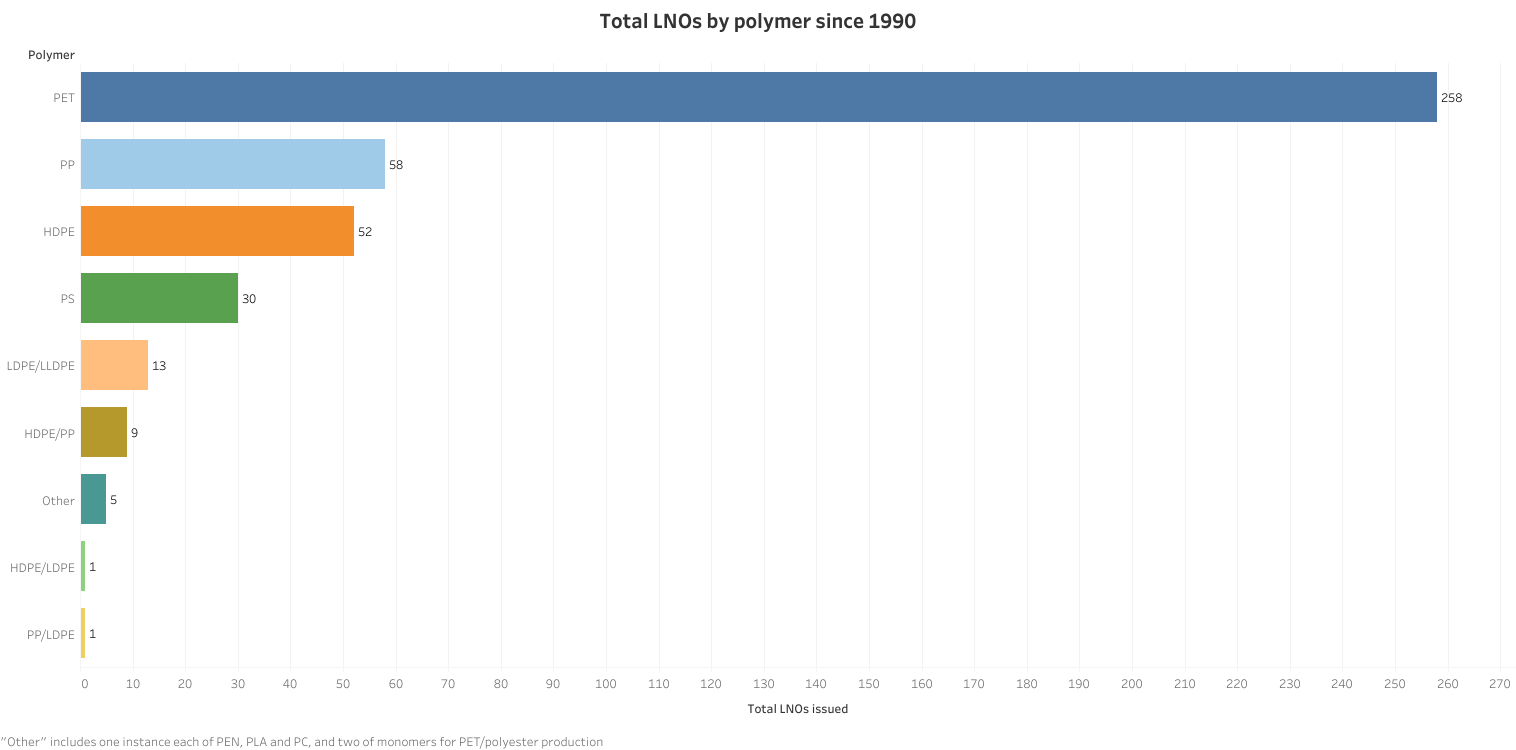
The US Food and Drug Administration issued the first letter of no objection (LNO, or NOL) for PET used in food-contact articles in January 1991. Since then, 258 LNOs have been issued for PET, more than four times PP and HDPE, the next highest polymers.

(For an interactive version of the chart below, and other data on FDA LNOs, click here for a Tableau visualization.)
However, building on that success requires data-driven policies that also consider real-world market conditions, and help protect existing infrastructure, Stewart added. 

Urging policy during a time of division

Even in the current climate of deep political division and pushback against “green” initiatives, bipartisan federal bills have surfaced to support recycling in various ways: recycled content claim standards, reuse and refill systems, design for recyclability, packaging disposal claims, chemical recycling and recycling infrastructure. 

Well-designed recycling policy can help strengthen domestic recycling capacity, improve collection and access, ensure recovered material is recycled domestically and support US manufacturing and jobs, Stewart said. 

“It is not only about ‘green,’ and what’s sustainable, but also the jobs and the livelihood that is behind each step in the process,” Stewart said, noting that there are thousands of jobs linked to every stage in the PET lifecycle, starting from the molecular building blocks all the way through to designing and fabricating equipment to converting the resin into everyday products. 

“It doesn’t matter what side of the [political] house you’re on, to know recycling is important,” Stewart said. 

Stewart pointed out that PET is the most recyclable plastic globally, with the US consistently above a 30% recycling rate for PET and a global rate over 50%. 

Although NAPCOR’s 2024 report, released in December 2025, showed slight decreases in several key metrics, the organization maintains that the North American PET industry is evolving, amid lightweighting and rising recycler acceptance of varied packaging types.  

For example, though bottle collection declined, at 39.2% it remained above global benchmarks. And a 52% increase in thermoform recovery offset declining bottle recovery, as total reclaimer inputs in the US and Canada grew by 1%. The report also indicates that the recycling system has gained efficiency. 

“But the reality is, we can do more and we need to look at policy and methods to increase the circularity of all PET plastic,” Stewart said. 

And the average recycled content in US PET bottles fell slightly in 2024, to 15.9%, driven by increased volumes of inexpensive virgin resin. “There is more opportunity to grow that number, especially if it’s sourced domestically or locally in EPR programs,” Stewart said. 

Policy priorities

The group is highlighting tried-and-true methods of increasing collection and supporting the industry, as well as more recent policy tactics. 

Beverage container deposit return systems (DRS) are in place in 10 states, and “we do know those work,” Stewart said. DRS states report higher recovery rates, as much as 80-90% of PET bottles. 

And while such programs may not have been updated in years, if not decades – for example, Michigan has provided a flat 10-cent incentive since 1989 – a bottle bill may be a good starting point for states that would struggle to pass a full packaging EPR bill. 

“Typically the consumer needs some kind of economic incentive to take that bottle and put it in the bin,” Geiger said. And with the high value of PET to recycling systems, “We’ve just got to have the mechanisms in place to be able to get those bottles returned.”

Other policy priorities for the group include extended producer responsibility (EPR) laws for packaging, beyond the current seven states that have adopted them, and design for recyclability. “It seems second nature that if you’re making a product, you’d like to think about the entire life of that product, including end of life,” Stewart said. 

Adhering to increasingly harmonized design guidelines including those from the Association of Plastic Recyclers (APR), for example, can help avoid a package ending up in a landfill, she added. 

APR owns Resource Recycling, Inc., publisher of Plastics Recycling Update.

The PET coalition also supports recycled content mandates, especially in the context of eco-modulation – assessing fees or incentivizing materials based on the relative environmental impact of a material. 

Ultimately, each of the potential policy remedies is a step along the journey, Stewart said. 

“I wish we could know state-by-state that by a certain date, we’ll have this policy in place, but really it starts with the basics – why PET is unique, that it’s the most recyclable plastic in the world, and things we can do collectively to improve collection to keep it out of the environment.”


Tags: EPRIndustry GroupsLegislation & EnforcementPET
TweetShare
Antoinette Smith

Antoinette Smith

Antoinette Smith has been at Resource Recycling Inc., since June 2024, after several years of covering commodity plastics and supply chains, with a special focus on economic impacts. She can be contacted at [email protected].

Related Posts

EPR rules take shape in Oregon, as first test

Oregon OKs end-market verification from CAA

byStefanie Valentic
May 20, 2026

The state's Department of Environmental Quality has given the stamp of approval on CAA's Responsible End Markets program plan amendment.

Revised CA budget includes $200m for recycling

Revised CA budget includes $200m for recycling

byAntoinette Smith
May 20, 2026

Stakeholders applauded the additional allocations proposed, but would like to see distribution re-formulated to more effectively address market realities.

Plastic packaging

Why SB 54 source reduction planning is becoming the industry’s most challenging EPR test

byDave Ford
May 19, 2026

Ahead of critical August deadlines, producers, packaging manufacturers and experts must decode SB 54's toughest requirement.

Niagara acquires rPlanet Earth assets in California

Niagara acquires rPlanet Earth assets in California

byAntoinette Smith
May 15, 2026

Adding the Southern California facility to its operations, Niagara is expanding its beverage manufacturing operations and pursuing vertical integration.

NJ e-scrap legislation

NJ qualifies PureCycle PP for minimum PCR law

byAntoinette Smith
May 14, 2026

The one-year conditional approval allows resin processed via the company's dissolution method to count toward the state's minimum recycled content...

Retail aisle with paper and plastic packaging.

Loblaw’s recyclability push could reshape packaging design across North America

byKeith Loria
May 14, 2026

The retailer is pursuing aggressive plans to ensure all packaging on its shelves is recyclable or reusable.

Load More
Next Post

Certification Scorecard — Week of May 11, 2026

More Posts

Bottle bill backers see opportunity for action

PET collapse exposes gaps in US recycling infrastructure

May 15, 2026
Revised CA budget includes $200m for recycling

Revised CA budget includes $200m for recycling

May 20, 2026
Plastic packaging

Why SB 54 source reduction planning is becoming the industry’s most challenging EPR test

May 19, 2026
Niagara acquires rPlanet Earth assets in California

Niagara acquires rPlanet Earth assets in California

May 15, 2026

Before the Bin: America’s textile waste problem starts in your closet

May 19, 2026
Industry descends on DC to fight for PET

Industry descends on DC to fight for PET

May 13, 2026
Extruder pushes out natural HDPE pellets at KW Plastics in Troy, Alabama.

Rare look inside the world’s largest plastics recycler

May 13, 2026
Aurubis: Thefts involved scrap sample manipulation

Metals and electronics recyclers report growth

May 20, 2026
Retail aisle with paper and plastic packaging.

Loblaw’s recyclability push could reshape packaging design across North America

May 14, 2026
Recycler cites market pressure in short-term closure

AI, data anxiety push enterprises to destroy working devices: report

May 19, 2026
Load More

About & Publications

About Us

Staff

Archive

Magazine

Work With Us

Advertise
Jobs
Contact
Terms and Privacy

Newsletter

Get the latest recycling news and analysis delivered to your inbox every week. Stay ahead on industry trends, policy updates, and insights from programs, processors, and innovators.

Subscribe

Welcome Back!

Login to your account below

Forgotten Password?

Retrieve your password

Please enter your username or email address to reset your password.

Log In

Add New Playlist

No Result
View All Result
  • The Latest
  • Analysis
  • Recycling
  • E-Scrap
  • Plastics
  • Policy Now
  • Conferences
    • E-Scrap Conference
    • Plastics Recycling Conference
    • Resource Recycling Conference
    • Textiles Recovery Summit
  • Magazine
  • About Us
  • Advertise
  • Archive
  • Jobs
  • Staff
Subscribe
This website uses cookies. By continuing to use this website you are giving consent to cookies being used. Visit our Privacy and Cookie Policy.