




Resource Recycling
  • The Latest
  • Analysis
    • All
    • Certification Scorecard
    • Industry Announcements
    • Opinion
    SERI works to restore faith in certifications

    Building a defensible E-scrap evidence file

    tires

    The most important decision in tire recycling happens before the shredder

    Intel sign outside of company building.

    Intel’s CapEx tops $20B on server demand while PC volume shrinks

    Google sign on company building with blue sky and clouds above.

    Inside Alphabet’s Q2 results: More capital spending and cloud backlog

    Alpek closing Pennsylvania RPET plant

    Alpek seizing on war-related opportunity 

    Our top stories from March 2023

    Iron Mountain’s data center report: Strong on power, quiet on hardware

  • Conferences
    • Resource Recycling Conference
    • Plastics Recycling Conference
    • E-Scrap: The Longevity Conference
    • Textiles Recovery Summit
  • Publications
    • E-Scrap News
    • Plastics Recycling Update
    • Policy Now
    • Resource Recycling
    • Other Topics
      • All Topics
      • Brand Owners
      • Critical Minerals
      • Glass
      • Grant Watch / RFPs
      • Markets
      • Organics
      • Packaging
      • Research
      • Technology
      • Textiles
Subscribe
No Result
View All Result
Resource Recycling
  • The Latest
  • Analysis
    • All
    • Certification Scorecard
    • Industry Announcements
    • Opinion
    SERI works to restore faith in certifications

    Building a defensible E-scrap evidence file

    tires

    The most important decision in tire recycling happens before the shredder

    Intel sign outside of company building.

    Intel’s CapEx tops $20B on server demand while PC volume shrinks

    Google sign on company building with blue sky and clouds above.

    Inside Alphabet’s Q2 results: More capital spending and cloud backlog

    Alpek closing Pennsylvania RPET plant

    Alpek seizing on war-related opportunity 

    Our top stories from March 2023

    Iron Mountain’s data center report: Strong on power, quiet on hardware

  • Conferences
    • Resource Recycling Conference
    • Plastics Recycling Conference
    • E-Scrap: The Longevity Conference
    • Textiles Recovery Summit
  • Publications
    • E-Scrap News
    • Plastics Recycling Update
    • Policy Now
    • Resource Recycling
    • Other Topics
      • All Topics
      • Brand Owners
      • Critical Minerals
      • Glass
      • Grant Watch / RFPs
      • Markets
      • Organics
      • Packaging
      • Research
      • Technology
      • Textiles
Subscribe
No Result
View All Result
Resource Recycling
No Result
View All Result
Home Recycling

APR: ‘There is no sustainability without recycling’

Colin StaubbyColin Staub
November 27, 2018
in Recycling

The head of the Association of Plastic Recyclers (APR) recently voiced concerns that plastics recovery progress could get dampened by stakeholders’ transition to more holistic approaches to materials management.

During a recent webinar, Steve Alexander of APR and an official from the U.S. Environmental Protection Agency discussed the evolution of  sustainable materials management and what it means for the plastics recycling industry.

Under a sustainable materials management approach, managing a product at end of life becomes just one component of reducing that product’s environmental impact. It’s not necessarily about lessening the importance of recycling, but introducing new factors into the discussion. It’s a concept being embraced by the U.S. EPA as well as states, waste companies and others.

But APR wants to make sure the work being done by the plastics recycling sector is not forgotten as the dialogue develops.

“Recycling is at the base of any sustainability movement,” said Steve Alexander, executive director of APR. “Frankly, there is no sustainability without recycling.”

What is the new approach?

During the Nov. 6 webinar, Ron Vance, chief of the resource conservation branch in the U.S. EPA’s Office of Land and Emergency Management, gave an overview of the sustainable materials management concept. It was developed as part of the EPA’s evolving work on solid waste management and materials use.

“We’re trying to look at materials at large and really trying to understand where they come from, where they go and everything that’s embedded within them,” Vance said.

That means considering the impacts from raw material sourcing through manufacturing, delivery to market, use by the consumer and end of life. This way of thinking moves beyond the original EPA areas of interest, which focused on landfill and disposal regulations. It even moves beyond the concept of “integrated waste management,” which emerged in the 1990s, Vance said.

The EPA’s version of sustainable materials management considers end-of-life management but also includes five earlier areas of focus throughout a product’s life.

“It’s not always about end of life,” Vance said. “It’s really understanding what happens across the life cycle, where those impacts occur and where the opportunities throughout the life cycle are to mitigate some of those impacts.”

And during the end-of-life management phase, Vance said, “reuse, recycling and whatnot come in as key roles in keeping that material in cycle, but it’s not the end-all, be-all of minimizing all of those impacts.”

‘Don’t want to de-emphasize recycling’

The plastics recycling industry has a “fundamental belief” that recycling must be a key component of sustainable materials management, Alexander said.

He pointed to the trend of major brand owners making recycling-related commitments, whether they’re pledges to use more recycled content, to make more recyclable products or other similar goals. Amid this rising interest, “the last thing we want to do is discourage companies from recycling,” Alexander said. “Not that EPA is doing that, but I think it’s important to highlight the role that recycling must continue to play within this sustainable materials management conundrum.”

One of the key concerns is that consumers and companies alike begin to place less focus on recycling, believing that the other pillars of sustainable materials management eclipse recycling in importance. It was a concern Alexander expressed in 2017, as well, after attending a plastic sustainability meeting that drew consumer product brand owners.

“We want people to continue to be more cognizant. We want companies and consumer brands to continue their commitment to utilizing recycling,” Alexander said.

He identified several strengths of recycling within the life cycle discussion, including that recycling facilitates a consumer connection to sustainability efforts.

“If you look at the other components of sustainable materials management, it’s about someone else doing something,” Alexander said. Recycling, on the other hand, engages the consumer.

“One of the most critical actions that people take is the decision that they make with that container in their hand, and do they put that in their trash or do they put that in their recycling bin.”

Another reason recycling is essential is that it will likely always have a role to play, according to APR. Manufacturers can work on source reduction, packaging innovation, life cycle analysis and reducing greenhouse gas emissions, but “at the end of the day, you’re still left with a product that has to be recycled,” Alexander said.

He indicated that the plastics recycling industry is not opposed to the factors a sustainable materials management approach promotes, such as examining greenhouse gas emissions for various materials. This year, APR completed a life cycle inventory analysis for using recycled resin versus virgin resin. The report, which is the first of its kind and will be released in the near future, highlights significant energy savings in transportation, resource consumption, emissions and other fields.

“I think that sometimes people miss how much contribution, from a life cycle and a greenhouse gas emission reduction [perspective], that using recycled resin contributes to sustainable materials management as well as sustainability in total,” Alexander said.

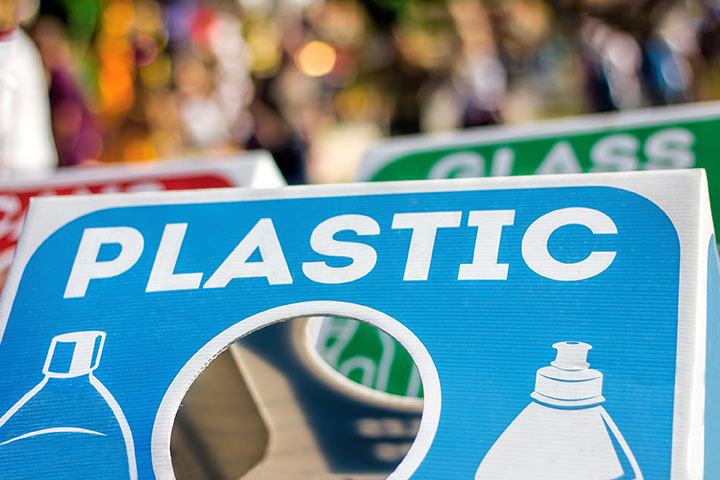
Photo credit: jgolby/Shutterstock

 

Tags: Industry GroupsPlastics
TweetShare
Colin Staub

Colin Staub

Colin Staub was a reporter and associate editor at Resource Recycling until August 2025.

Related Posts

Amazon plastic use flat despite shift to paper

Amazon plastic use flat despite shift to paper

byAntoinette Smith
July 22, 2026

In its latest sustainability report, the e-commerce giant noted a decrease of less than 1% for volumes of single-use plastic...

RecyClass hits 500 EU recyclability evals

RecyClass hits 500 EU recyclability evals

byAntoinette Smith
July 21, 2026

The most recent evaluations include Avery Dennison's RFID tag for PET bottles, ahead of the first PPWR enforcement in mid-August.

Surveys examine gaps in consumer recycling education

Interest up, volume down for battery recycling

byPaul Lane
July 21, 2026

Online engagement spurred a spike in battery collection sites, according to The Battery Network, although total participation fell slightly on...

Former president of CRT processor sentenced to prison

Groups say injunction doesn’t settle labeling issues

byStefanie Valentic
July 17, 2026

Californians Against Waste and the National Stewardship Action Council say a federal injunction blocking SB 343 pauses enforcement but still...

US recycling rates rise despite drop in bottles

byAntoinette Smith
July 16, 2026

Although rates saw slight gains over two years, the data highlight the need for policy solutions to unlock growth in...

Federal funds boost critical mineral research efforts

Federal funds boost critical mineral research efforts

byPaul Lane
July 16, 2026

A Midwest consortium plans to use the money to build up domestic mineral recovery and processing efforts.

Load More
Next Post

Taiwan joins countries curbing scrap imports

2026 Buyers’ Guide

Equipment, services and technology suppliers serving the recycling industry.

Browse the Guide

More Posts

State policy is redefining plastics recycling in the US

State policy is redefining plastics recycling in the US

February 19, 2026
California bill would set up EPR for batteries

California bill would set up EPR for batteries

May 12, 2022
Closeup of a printed circuitboard

Hardware demand puts new focus on parts harvesting

June 5, 2026

In other news: May 2, 2016

May 2, 2016
Apple store

Apple leads on inputs, faces questions on ITAD

May 1, 2026
Analysis: circular design still elusive in laptops

PC shipments grew in Q1, but questions remain

April 23, 2026

Recycled copper output climbs as market shows surplus

April 6, 2026
Ten e-scrap projects receive federal prize funds

Recycling rates for rare earths could double by 2040

July 17, 2026

Alpla decries ‘painful impact’ of recycling market pressures

January 19, 2026
Top stories from August 2024

Top stories from August 2024

September 6, 2024
Load More

About & Publications

About Us

Staff

Archive

Magazine

Work With Us

Advertise
Jobs
Contact
Terms and Privacy

Newsletter

Get the latest recycling news and analysis delivered to your inbox every week. Stay ahead on industry trends, policy updates, and insights from programs, processors, and innovators.

Subscribe

Welcome Back!

Login to your account below

Forgotten Password?

Retrieve your password

Please enter your username or email address to reset your password.

Log In

Add New Playlist

No Result
View All Result
  • The Latest
  • Analysis
  • Recycling
  • E-Scrap
  • Plastics
  • Policy Now
  • Conferences
    • E-Scrap Conference
    • Plastics Recycling Conference
    • Resource Recycling Conference
    • Textiles Recovery Summit
  • Magazine
  • About Us
  • Advertise
  • Archive
  • Jobs
  • Staff
Subscribe
This website uses cookies. By continuing to use this website you are giving consent to cookies being used. Visit our Privacy and Cookie Policy.