





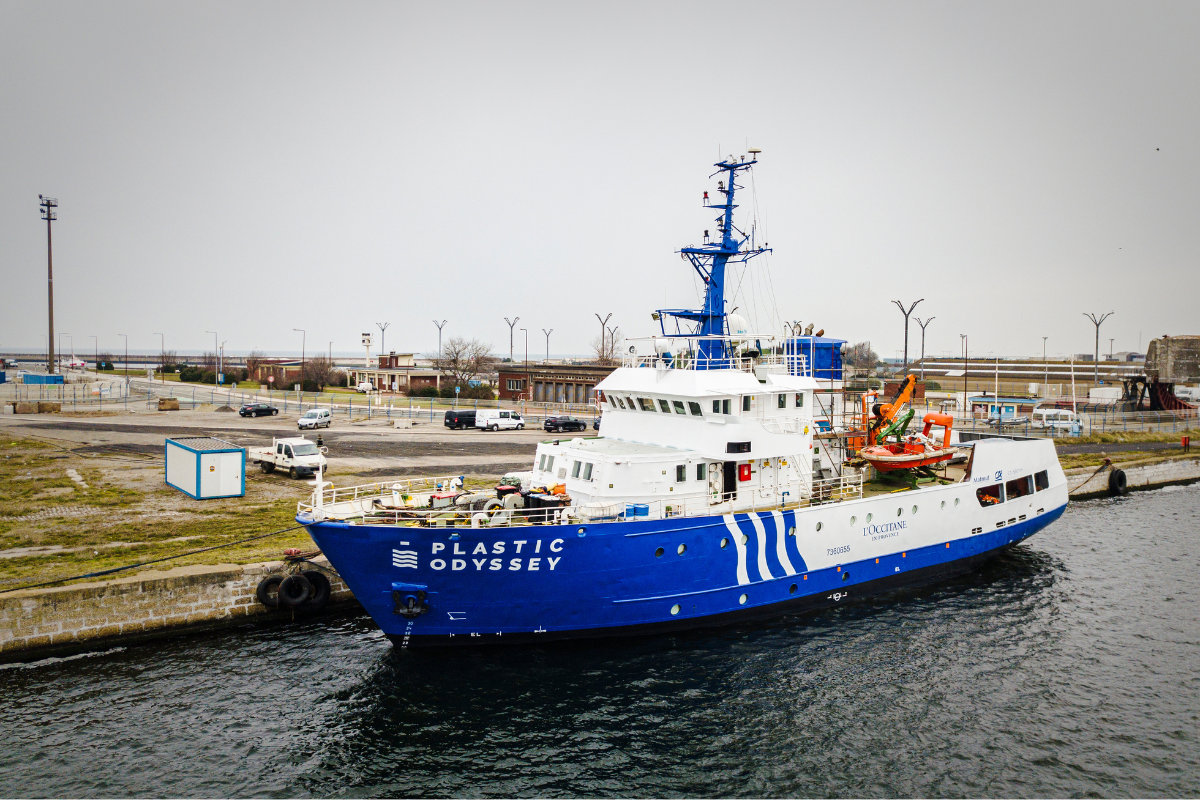
It’s been nearly 18 months since a 128-foot vessel embarked on a global voyage to share knowledge and equipment with communities facing plastic pollution management challenges. A leader of the Plastic Odyssey project reported on the progress in an interview.
The project, which Resource Recycling detailed in 2021, kicked off in November 2022, when the vessel began its journey in the Mediterranean Sea. Since then, it’s completed about 20 stopovers in as many countries, with a broad mission to demonstrate technology to local recycling companies, if there are any, or otherwise interested entrepreneurs.
The project provides concrete and workable plans for action to address a problem that can often feel overwhelming, said Simon Bernard, Plastic Odyssey’s president.
“My feeling is that there are a lot of people interested in doing stuff, acting, but they don’t know what to do,” he said in an interview. “So that’s really, I think, where our expertise is: just bringing solutions, showing concrete stuff you can do instead of talking about the problem.”
“It’s really focusing on stuff you can do tomorrow, basically,” Bernard added.
The vessel has also completed several plastic pollution cleanups during its voyage, including at the infamous heavily polluted Henderson Island, a deserted island in the south Pacific Ocean.
The project, which has been funded through sponsorship by private companies, is currently headed through the Pacific Ocean bound for Asia, with stops planned in Fiji and New Caledonia before reaching Indonesia. Plastic Odyssey plans to be at sea at least through the end of 2025.
Meeting the local need
Before the ship pulls into a port, the Plastic Odyssey communications team has already located local recycling stakeholders to contact. Bernard noted it can sometimes be difficult to find the recycling processors in a given community because they can be operating in out-of-the-way industrial locations, so the communication team is key.
On the ground, the Plastic Odyssey team generally holds a press conference and invites the local recycling stakeholders to attend. Sometimes it will draw government representatives, such as the country’s minister of environment. But Plastic Odyssey’s prime focus is providing tools and ideas to local entrepreneurs to develop successful recycling businesses, rather than holding talks with government officials.
If there is a local plastics recycling operator, the team talks with the company about what processes they’re using currently, learns what the company needs to improve its process and tries to provide ideas for improvement.
As one example, during a visit to Conakry, Guinea, in 2022, the team met a local recycling entrepreneur running a company called Binedou Global Service, which was using a low-tech process to melt plastic, add sand and produce paving stones for sidewalks.
When Plastic Odyssey first visited the company, it was producing about 100 pavers a day and wanted to expand. After visiting and learning what the company needed, Plastic Odyssey was able to facilitate installation of a shredder, sand-mixer, extruder and presses to improve and expand the process, allowing production of 500 pavers per day.
If there isn’t a local recycling firm, the team tries to build the foundation for one by engaging entrepreneurs who are interested in the materials recovery business. Bernard gave an example of the team’s experience in Tahiti, where they contacted many local entrepreneurs who had experience building factories but who had no knowledge of plastics recycling.
“That’s where we can show them what type of machines they will need, and test and prototype with them,” Bernard said.
One way Plastic Odyssey has successfully started up a recycling operation is through deploying a plastics reclamation and manufacturing micro-facility that’s entirely contained within a shipping container. This is the solution the team brought to Binedou Global Service in Guinea.
These are “turnkey solutions, where you have a shredder, extruder, molds and you can basically install the container in some remote place, put in plastic waste and get a finished product,” Bernard said. It’s a fairly straightforward process, taking in commingled scrap plastic and producing durable goods like plastic pallets or building materials like pavers, as in Guinea.
Plastic Odyssey has piloted three of the micro-factories in Guinea, Togo and Djibouti, and it’s working on a fourth in Côte d’Ivoire.
Learning goes both ways
Stopovers also include weeklong seminars aboard the ship that local stakeholders can apply for. These events, which the team calls “OnBoard Laboratories,” are intensive information-sharing opportunities featuring people from diverse specialties. For example, during a stopover in Colombia, the onboard seminar drew professors, leaders in Colombian waste collection, managers of plastic storage and processing facilities, recycling machine manufacturers and engineering consultants.
The events include technical education using the ship’s onboard recycling equipment for demonstration, workshops and entrepreneur training. They typically include 10 to 15 local stakeholders, but occasionally, the interest is overwhelming. In the Dominican Republic, for instance, 300 people applied to join the seminar. Rather than reject scores of applicants, the Plastic Odyssey team shifted to renting a large room to accommodate many more people and held the event more as a class than a small-group discussion.
Bernard noted his team’s typical approach of inviting local recycling stakeholders to stay on board for a week helps to get everyone comfortable with sharing information about their operations. If it was just a group of outsiders showing up and asking details about local recycling company operations, Bernard noted people could be less willing to open up about how they operate.
“We have this boat, we have this factory, and we can teach them what we’ve seen around the world, connect them with people that are doing the same job,” Bernard said.
Through connecting local stakeholders – who often didn’t know there were other folks interested in developing recycling infrastructure – Plastic Odyssey aims to foster a sustaining impact after the boat leaves the port.
“After the week, everything is possible,” Bernard said.
Remote island cleanup
Besides education and stakeholder connection, the Plastic Odyssey project has included a unique environmental cleanup component.
During its voyage, the ship stopped at Henderson Island, one of the Pitcairn Islands in the Pacific Ocean. An uninhabited island and a UNESCO World Heritage site, the location has garnered international attention as a major site of plastic pollution. Despite having no residents, the island has accumulated huge amounts of debris – an estimated 38 million pieces of plastic waste as of 2019 – because of ocean plastic pollution collecting on its shores.
Plastic Odyssey stopped at the island in February 2024 and worked on a cleanup effort for a month.
“The beach was completely covered with plastic waste, 9 tons of plastic waste,” Bernard said. “And the thing was, it was very complicated to remove it because of the coral reef.”
Crossing the reef is treacherous, which is one reason a 2019 cleanup effort ended up leaving bags of collected trash, about 14,000 pounds in total, on the island above the high-tide line. Plastic Odyssey set out to remove that material, and it employed creative tactics to do so.
“One of the techniques that we used that worked pretty well was using a parasail,” Bernard said.
That involved attaching the bags to a parasail to lift them over the coral reef and tow them into the ship. The crew also experimented with methods like using a pontoon and using connected buoys to float the bags over the reef and then tow them into the boat.
The project was documented in depth on Plastic Odyssey’s website.
A version of this story appeared in Plastics Recycling Update on Apr. 24.