




Resource Recycling
  • The Latest
  • Analysis
    • All
    • Certification Scorecard
    • Industry Announcements
    • Opinion
    SERI works to restore faith in certifications

    Building a defensible E-scrap evidence file

    tires

    The most important decision in tire recycling happens before the shredder

    Intel sign outside of company building.

    Intel’s CapEx tops $20B on server demand while PC volume shrinks

    Google sign on company building with blue sky and clouds above.

    Inside Alphabet’s Q2 results: More capital spending and cloud backlog

    Alpek closing Pennsylvania RPET plant

    Alpek seizing on war-related opportunity 

    Our top stories from March 2023

    Iron Mountain’s data center report: Strong on power, quiet on hardware

  • Conferences
    • Resource Recycling Conference
    • Plastics Recycling Conference
    • E-Scrap: The Longevity Conference
    • Textiles Recovery Summit
  • Publications
    • E-Scrap News
    • Plastics Recycling Update
    • Policy Now
    • Resource Recycling
    • Other Topics
      • All Topics
      • Brand Owners
      • Critical Minerals
      • Glass
      • Grant Watch / RFPs
      • Markets
      • Organics
      • Packaging
      • Research
      • Technology
      • Textiles
Subscribe
No Result
View All Result
Resource Recycling
  • The Latest
  • Analysis
    • All
    • Certification Scorecard
    • Industry Announcements
    • Opinion
    SERI works to restore faith in certifications

    Building a defensible E-scrap evidence file

    tires

    The most important decision in tire recycling happens before the shredder

    Intel sign outside of company building.

    Intel’s CapEx tops $20B on server demand while PC volume shrinks

    Google sign on company building with blue sky and clouds above.

    Inside Alphabet’s Q2 results: More capital spending and cloud backlog

    Alpek closing Pennsylvania RPET plant

    Alpek seizing on war-related opportunity 

    Our top stories from March 2023

    Iron Mountain’s data center report: Strong on power, quiet on hardware

  • Conferences
    • Resource Recycling Conference
    • Plastics Recycling Conference
    • E-Scrap: The Longevity Conference
    • Textiles Recovery Summit
  • Publications
    • E-Scrap News
    • Plastics Recycling Update
    • Policy Now
    • Resource Recycling
    • Other Topics
      • All Topics
      • Brand Owners
      • Critical Minerals
      • Glass
      • Grant Watch / RFPs
      • Markets
      • Organics
      • Packaging
      • Research
      • Technology
      • Textiles
Subscribe
No Result
View All Result
Resource Recycling
No Result
View All Result
Home Recycling

New York again aiming for packaging EPR

Marissa HeffernanbyMarissa Heffernan
May 3, 2024
in Recycling
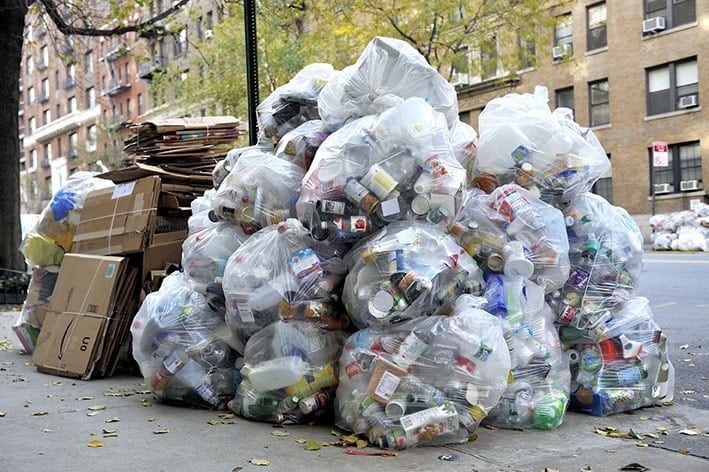
The Packaging Reduction and Recycling Infrastructure Act AB 5322 in the Assembly Codes committee and its companion bill, SB 4246, is in the Senate finance committee. | robert-paul-van-beet/Shutterstock

New York legislators are once again pushing to become the fifth state in the U.S. to implement extended producer responsibility for packaging.  

The Packaging Reduction and Recycling Infrastructure Act, AB 5322, and its Senate companion bill, SB 4246, were revived late in last year’s session. 

Both bills are still in committees in their houses of origin, AB 5322 in the Assembly Codes committee and SB 4246 in the Senate finance committee. The New York legislature adjourns in early June. 

Bill details 

The proposal calls for the creation of a packaging reduction and recycling organization, similar to a producer responsibility organization. Producers would be required to join and pay fees into the organization to achieve the goals set out in the law and to reimburse local governments and private companies “for the costs associated with the implementation of reduction, refill and reuse programs, and the collection, transportation and recycling, disposal or other processing of packaging materials.” 

If passed, the packaging reduction organization would have two years to develop and submit a packaging reduction and recycling plan and carry out a needs assessment. 

A5322 would also form a toxic packaging task force and a packaging reduction and recycling advisory council and require the packaging reduction and recycling organization to provide the option to purchase recycled materials from processors.

The reduction rates laid out in the bill are 10% by unit weight three years after a producer first registers with an organization, 20% five years after, 30% eight years after, 40% 10 years after and 50% 12 years after joining. 

The post-consumer recycled content targets are broken down by material type. For all glass containers manufactured in the state, the rate is at least 35% two years after the law becomes effective. For paper carryout bags it’s 40% unless the bag holds 8 pounds or less, in which case the target is 20%. 

For all plastic trash bags sold or offered for sale in the state the target is 20% post-consumer recycled content.

Recycling rate targets are different for plastic and non-plastic packaging. For non-plastic packaging, the rates are 35% reused or recycled, with at least 5% of that reused, by 2028. In 2035, the rates jump to 50% reused or recycled with at least 10% reused, and by 2050, the rates are 75% reused or recycled with at least 20% reused. 

Plastic packaging must be 25% reused or recycled by 2028, 50% by 2035 and 75% by 2050. 

The law covers paper, cardboard, corrugated cardboard, wood, glass, PET, HDPE, expanded polystyrene, polystyrene, bio-plastics, generic plastics, plastic film, steel or ferrous, aluminum, tinplate, generic metals and mixed materials, including laminates. 

The fees for those covered materials can be adjusted based on the cost to process the materials, if the material is readily recyclable and the commodity value. The fees are also eco-modulated, so those with more post-consumer recycled material content and those producers that reduce packaging, increase their proportion of packaging managed within a reuse and refill system, improve recyclability, reduce toxic components or reduce litter will receive credits or pay lower fees. 

The prohibition on toxic substances and materials would begin two years after the promulgation of rules and regulations and would cover orthophthalates, bisphenols, PFAS, heavy metals and other compounds, including lead, hexavalent chromium, cadmium and mercury, benzophenone and its derivatives, halogenated flame retardants, perchlorate, formaldehyde, toluene, antimony and compounds, carbon black, UV 328, polyvinyl chloride, polystyrene and polycarbonate.

Reactions and concerns 

A Beyond Plastics press release called the bill “the most comprehensive packaging reduction legislation in the country.” More than 200 groups signed a letter of support for the legislation, including the Natural Resources Defense Council, New York Public Interest Research Group, the League of Women Voters of New York State, several religious organizations and Surfrider. 

“Because packaging will be reduced, reused, or redesigned to be truly recyclable, recycling facilities will no longer be inundated with worthless plastic waste,” the groups said. “New funding will help local governments support effective recycling of metal, paper, cardboard and glass and, most importantly, reuse and refill programs.” 

Betsy Bowers, executive director of the EPS Industry Alliance, said she’s concerned about the chemical prohibition section of the bill.

“The chemical review process is already well covered under the federal agencies and under the WHO,” she said, referring to the World Health Organization. “A lot of the regulations and legislation that we see is targeted at single-use plastics, and the FDA has some pretty stringent criteria that has to be met to ensure the safety and so forth.” 

Bowers noted that some of those chemicals on the list also appear in other materials, and as she reads it, the bill could also ban paper. 

The list also includes “several chemicals you’d expect to see on any list of this type, but it mixes up polymers with chemicals,” Bowers added. 

For example, polystyrene is on the list with toluene, which is a chemical used to make polystyrene, and with heavy metals such as cadmium, which is used to make paper, she said. “The way the bill is drafted right now, our interpretation is that a multitude of packaging materials could be restricted. 

“We think that EPR is really a crucial policy approach that can really help move us to the next level, an improvement level, but including the chemicals is just really difficult,” she added. “We’re just concerned that it’s a duplicating effort that is going to cost the state of New York a lot of money. It’s not a case of industry not wanting to do its part or take responsibility.” 

Bower recommended that the bill “pursue a more traditional EPR path and leave the chemical restrictions” to another time.”


Tags: EPRLegislation & EnforcementPolicy Now
TweetShare
Marissa Heffernan

Marissa Heffernan

Marissa Heffernan worked at Resource Recycling from January 2022 through June 2025, first as staff reporter and then as associate editor. Marissa Heffernan started working for Resource Recycling in January 2022 after spending several years as a reporter at a daily newspaper in Southwest Washington. After developing a special focus on recycling policy, they were also the editor of the monthly newsletter Policy Now.

Related Posts

Spin-off lets Linca focus on battery mineral recovery

GAO: Policy, tech updates needed to bolster domestic mineral supply

byPaul Lane
July 30, 2026

Federal investigators say short- and long-term solutions are needed to decrease the nation’s reliance upon foreign-based minerals.

The State of Oregon seal at a park in Salem, Ore.

MRM bids to run Oregon EPR for second year 

byPaul Lane
July 28, 2026

The company won the competitive process for 2026, but was the only company to apply for the 2027 PRO post.

California releases deposit system update draft rules

Groups move to intervene in SB 343 lawsuit

byStefanie Valentic
July 27, 2026

Earth Island Institute and Californians Against Waste have filed to intervene in the federal lawsuit that halted enforcement of California's...

U.S. Capitol building in Washington, D.C.

House committees advance critical mineral bills

byPaul Lane
July 27, 2026

Congressional votes earlier this month advanced three bills that would expand the nation’s critical mineral recycling capabilities. A subcommittee within...

A call to action: End markets and EPR

EPR faces several key questions

byBrian Clark Howard
July 23, 2026

Panelists discuss the promise and perils of EPR nationwide at the PROP conference in Pennsylvania.

RecyClass hits 500 EU recyclability evals

RecyClass hits 500 EU recyclability evals

byAntoinette Smith
July 21, 2026

The most recent evaluations include Avery Dennison's RFID tag for PET bottles, ahead of the first PPWR enforcement in mid-August.

Load More
Next Post

News from Ameripen, Colorado's Producer Responsibility Advisory Board and more

2026 Buyers’ Guide

Equipment, services and technology suppliers serving the recycling industry.

Browse the Guide

More Posts

State policy is redefining plastics recycling in the US

State policy is redefining plastics recycling in the US

February 19, 2026
California bill would set up EPR for batteries

California bill would set up EPR for batteries

May 12, 2022
Closeup of a printed circuitboard

Hardware demand puts new focus on parts harvesting

June 5, 2026
Apple store

Apple leads on inputs, faces questions on ITAD

May 1, 2026

In other news: May 2, 2016

May 2, 2016
Analysis: circular design still elusive in laptops

PC shipments grew in Q1, but questions remain

April 23, 2026

Recycled copper output climbs as market shows surplus

April 6, 2026
Ten e-scrap projects receive federal prize funds

Recycling rates for rare earths could double by 2040

July 17, 2026

Alpla decries ‘painful impact’ of recycling market pressures

January 19, 2026
Top stories from August 2024

Top stories from August 2024

September 6, 2024
Load More

About & Publications

About Us

Staff

Archive

Magazine

Work With Us

Advertise
Jobs
Contact
Terms and Privacy

Newsletter

Get the latest recycling news and analysis delivered to your inbox every week. Stay ahead on industry trends, policy updates, and insights from programs, processors, and innovators.

Subscribe

Welcome Back!

Login to your account below

Forgotten Password?

Retrieve your password

Please enter your username or email address to reset your password.

Log In

Add New Playlist

No Result
View All Result
  • The Latest
  • Analysis
  • Recycling
  • E-Scrap
  • Plastics
  • Policy Now
  • Conferences
    • E-Scrap Conference
    • Plastics Recycling Conference
    • Resource Recycling Conference
    • Textiles Recovery Summit
  • Magazine
  • About Us
  • Advertise
  • Archive
  • Jobs
  • Staff
Subscribe
This website uses cookies. By continuing to use this website you are giving consent to cookies being used. Visit our Privacy and Cookie Policy.