





Resource Recycling
  • The Latest
  • Analysis
    • All
    • Certification Scorecard
    • Industry Announcements
    • Opinion

    ITAD is moving past its adolescent phase: beyond end-of-life

    Rainforest

    Inside the Circle: What the rainforest can teach us about EPR

    Closeup of a printed circuitboard

    Hardware demand puts new focus on parts harvesting

    Rare look inside the world’s largest plastics recycler

    Mass balance matters: Why different rules can lead to different outcomes 

    Certification Scorecard — Week of June 1, 2026

    IT asset disposition and electronics recycling: Now and then

    $60 billion in AI servers will create an ITAD challenge

  • Conferences
    • Resource Recycling Conference
    • Plastics Recycling Conference
    • E-Scrap: The Longevity Conference
    • Textiles Recovery Summit
  • Publications
    • E-Scrap News
    • Plastics Recycling Update
    • Policy Now
    • Resource Recycling
    • Other Topics
      • All Topics
      • Brand Owners
      • Critical Minerals
      • Glass
      • Grant Watch / RFPs
      • Markets
      • Organics
      • Packaging
      • Research
      • Technology
      • Textiles
Subscribe
No Result
View All Result
Resource Recycling
  • The Latest
  • Analysis
    • All
    • Certification Scorecard
    • Industry Announcements
    • Opinion

    ITAD is moving past its adolescent phase: beyond end-of-life

    Rainforest

    Inside the Circle: What the rainforest can teach us about EPR

    Closeup of a printed circuitboard

    Hardware demand puts new focus on parts harvesting

    Rare look inside the world’s largest plastics recycler

    Mass balance matters: Why different rules can lead to different outcomes 

    Certification Scorecard — Week of June 1, 2026

    IT asset disposition and electronics recycling: Now and then

    $60 billion in AI servers will create an ITAD challenge

  • Conferences
    • Resource Recycling Conference
    • Plastics Recycling Conference
    • E-Scrap: The Longevity Conference
    • Textiles Recovery Summit
  • Publications
    • E-Scrap News
    • Plastics Recycling Update
    • Policy Now
    • Resource Recycling
    • Other Topics
      • All Topics
      • Brand Owners
      • Critical Minerals
      • Glass
      • Grant Watch / RFPs
      • Markets
      • Organics
      • Packaging
      • Research
      • Technology
      • Textiles
Subscribe
No Result
View All Result
Resource Recycling
No Result
View All Result
Home Recycling

Oregon offers first test as EPR rules take shape

byScott Snowden
October 21, 2025
in Recycling
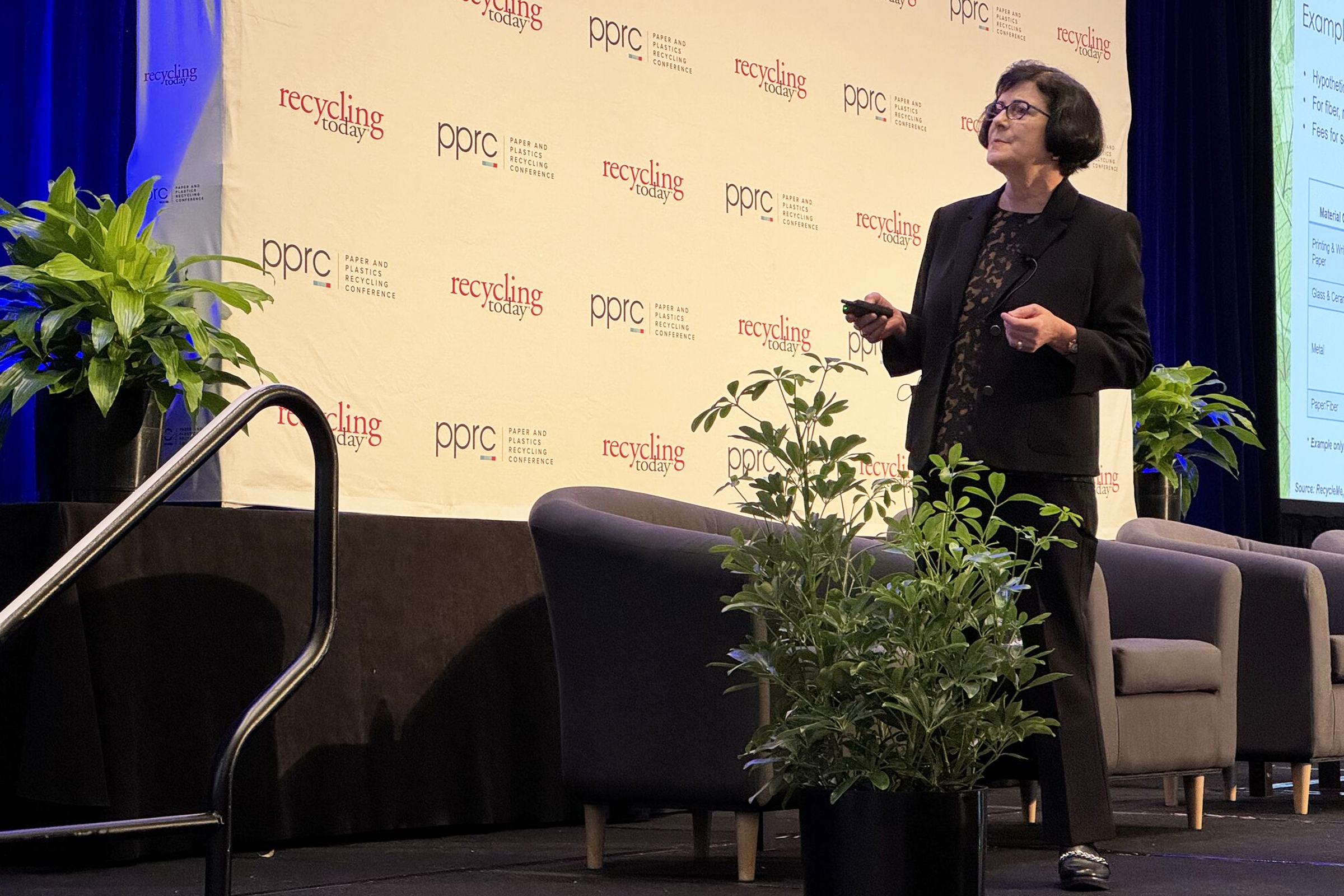
Susan Cornish told the PPRC audience that packaging EPR aims to build circularity through producer fees, stronger data and shared standards as states move to align their rules. | Courtesy Recycling Today

At the Paper and Plastics Recycling Conference in Chicago, industry leaders said extended producer responsibility (EPR) programs for packaging are changing how the US handles residential recycling, but warned that uneven state rules will slow the transition.

Moderator Bill Moore, president of Moore and Associates, opened the workshop and framed the stakes for producers, MRFs and mills that are preparing for new reporting and funding flows. He said one core premise of EPR is that the funding model for residential recycling services shifts away from the local level.

“EPR is supposed to fund residential recycling programs, which are currently coming at taxes or fees,” Moore said during the session. “But EPR has a lot of costs associated with it and I suspect there will be a lot of passing on.”

Consultant Susan Cornish walked through where laws stand and how programs work. Seven states have passed packaging EPR, and Oregon is the first mover on implementation, while California, Colorado, Maine, Minnesota, Maryland and Washington are at earlier stages. Several other states, including Illinois, are studying needs or advancing new bills.

“The concept is better circularity for packaging,” Cornish said. Under a typical EPR program, producers must enroll with a producer responsibility organization (PRO), report packaging sold in each state by substrate and form, and pay fees that reflect recyclability, processing cost and the value of recovered material. She said producers should expect significant adjustments in year two as methods and categories are refined by the program operator.

PRO Circular Action Alliance (CAA) manages several EPR programs and is working to harmonize definitions and reporting so companies do not face a different rulebook in every state, she said. She also noted that chemical recycling processes do not count toward post-consumer resin requirements and that composting pathways are included in California and Minnesota legislation.

Dan Gee, also of Moore and Associates, focused on responsible end markets, the qualification standard Oregon adopted for downstream buyers of recyclables under EPR. He said the framework requires legal compliance, chain of custody documentation, a minimum yield and environmental management systems, with self-attestation followed by third-party auditing on a set cycle.

“Oregon’s kind of the pace setter for responsible end markets,” he said. He added that Oregon set a minimum 60% yield for paper mills to qualify, which has raised questions about how proprietary operating data will be handled. He said the operator plans to rely on third-party auditors and aggregated reporting to protect confidentiality while verifying compliance. Early feedback from brokers and one MRF indicated they expect to direct more shipments to REM-approved domestic mills rather than export markets and acknowledged that the real work begins during the first full year of operation.

Moore said EPR can push design change and recovery of hard-to-recycle materials if programs are fine-tuned over time. He emphasized that the early phase will be iterative and that program operators and regulators will need to smooth friction points as they emerge.

After the session, Moore told Resource Recycling that the likely outcome is steady change rather than abrupt transformation. “The upside is that EPR pushes more recycling and pushes more recycling of difficult-to-recycle materials and develops the end markets,” he said. “The issue is really, I think, a complexity, and it’s going to take us some time to get through it. These things are going to be modified over time to make them more effective and efficient.”

He also said that national politics are unlikely to drive near-term outcomes because solid waste and recycling policy is formed at the state level. “The EPA doesn’t really control it,” he said. He added that federal interest has surfaced before but does not appear active at the moment.

Moore said history points toward eventual harmonization once enough states are in motion and producers seek a single framework. “Once a few states pass it, producers say, ‘Give us one federal rule so we can make the same product everywhere.’ That’s the history of all environmental legislation,” he said.

For now, the panelists said the focus is on accurate data, clear chain of custody, and program designs that reward recyclability and verified end-market performance while keeping industry input in view as rules mature.


Tags: EPRPolicy Now
TweetShare
Scott Snowden

Scott Snowden

Scott has been a reporter for over 25 years, covering a diverse range of subjects from sub-atomic cold fusion physics to scuba diving off the Great Barrier Reef. He's now deeply invested in the world of recycling, green tech and environmental preservation.

Related Posts

Three-bill package aims to revamp Michigan’s bottle return system

byStefanie Valentic
June 9, 2026

Michigan lawmakers introduced a bipartisan three-bill package aimed at strengthening consumer access to bottle deposit refunds and clarifying retailer obligations...

House resolution aims to make recyclability central to product design

NY EPR bill fails to advance after third try

byStefanie Valentic
June 8, 2026

This marks the third session in which the bill cleared the Senate only to stall in the Assembly.

Rainforest

Inside the Circle: What the rainforest can teach us about EPR

byBill Shireman
June 8, 2026

We have a lot to learn from jungles, particularly as we fight the thorny problem of plastic pollution.

CalRecycle withdraws proposed regs for SB 54

Oceana, NRDC, CAW sue CalRecycle over SB 54 regs

byStefanie Valentic
June 5, 2026

The groups allege that the new regulations have too many loopholes for packaging producers.

Rare look inside the world’s largest plastics recycler

Mass balance matters: Why different rules can lead to different outcomes 

bySarah Edwards, Eunomia
June 5, 2026

Mass balance is a critical piece of the recycling puzzle—and one that's important to get right.

Circular Materials to supply PlasCred chem recycling plant

Circular Materials to supply PlasCred chem recycling plant

byAntoinette Smith
June 4, 2026

The planned chemical recycling plant in Alberta, Canada, also has a five-year, fixed price offtake contract, ahead of reaching a...

Load More
Next Post

Coated paper group plans for EPR rollouts

More Posts

Recycling industry addresses Beyond Plastics report

Recycling industry addresses Beyond Plastics report

May 26, 2026
Fire at an EMR recycling facility in Camden, New Jersey May 29, 2026.

EMR faces shutdown calls after numerous fires

June 2, 2026
House resolution aims to make recyclability central to product design

NY EPR bill fails to advance after third try

June 8, 2026
IT asset disposition and electronics recycling: Now and then

$60 billion in AI servers will create an ITAD challenge

June 3, 2026
CalRecycle withdraws proposed regs for SB 54

Oceana, NRDC, CAW sue CalRecycle over SB 54 regs

June 5, 2026
The independent ITAD at a crossroads

DMD acquires ITAD firm Lifespan, outlines acquisition strategy

June 2, 2026
Our top stories from June 2021

Colorado advances EV battery EPR law

June 3, 2026
In My Opinion: Comparing the nation’s first packaging EPR laws

What Maine’s vape EPR law means for recyclers

June 4, 2026
Circular Materials to supply PlasCred chem recycling plant

Circular Materials to supply PlasCred chem recycling plant

June 4, 2026
Rare look inside the world’s largest plastics recycler

Mass balance matters: Why different rules can lead to different outcomes 

June 5, 2026
Load More

About & Publications

About Us

Staff

Archive

Magazine

Work With Us

Advertise
Jobs
Contact
Terms and Privacy

Newsletter

Get the latest recycling news and analysis delivered to your inbox every week. Stay ahead on industry trends, policy updates, and insights from programs, processors, and innovators.

Subscribe

Welcome Back!

Login to your account below

Forgotten Password?

Retrieve your password

Please enter your username or email address to reset your password.

Log In

Add New Playlist

No Result
View All Result
  • The Latest
  • Analysis
  • Recycling
  • E-Scrap
  • Plastics
  • Policy Now
  • Conferences
    • E-Scrap Conference
    • Plastics Recycling Conference
    • Resource Recycling Conference
    • Textiles Recovery Summit
  • Magazine
  • About Us
  • Advertise
  • Archive
  • Jobs
  • Staff
Subscribe
This website uses cookies. By continuing to use this website you are giving consent to cookies being used. Visit our Privacy and Cookie Policy.