



Resource Recycling
  • The Latest
  • Analysis
    • All
    • Certification Scorecard
    • Industry Announcements
    • Opinion
    Top stories from March 2025

    3 factors force e-scrap processing onshore

    Data center boom sets up ITAD growth

    Certification Scorecard — Week of June 15, 2026

    Tzvika Shahaf of Blancco

    Blancco names new SVP of product strategy

    IT security driving plans, reshaping budgets

    Study cuts projected AI server e-waste by 90%

    A call to action: End markets and EPR

    A call to action: End markets and EPR

  • Conferences
    • Resource Recycling Conference
    • Plastics Recycling Conference
    • E-Scrap: The Longevity Conference
    • Textiles Recovery Summit
  • Publications
    • E-Scrap News
    • Plastics Recycling Update
    • Policy Now
    • Resource Recycling
    • Other Topics
      • All Topics
      • Brand Owners
      • Critical Minerals
      • Glass
      • Grant Watch / RFPs
      • Markets
      • Organics
      • Packaging
      • Research
      • Technology
      • Textiles
Subscribe
No Result
View All Result
Resource Recycling
  • The Latest
  • Analysis
    • All
    • Certification Scorecard
    • Industry Announcements
    • Opinion
    Top stories from March 2025

    3 factors force e-scrap processing onshore

    Data center boom sets up ITAD growth

    Certification Scorecard — Week of June 15, 2026

    Tzvika Shahaf of Blancco

    Blancco names new SVP of product strategy

    IT security driving plans, reshaping budgets

    Study cuts projected AI server e-waste by 90%

    A call to action: End markets and EPR

    A call to action: End markets and EPR

  • Conferences
    • Resource Recycling Conference
    • Plastics Recycling Conference
    • E-Scrap: The Longevity Conference
    • Textiles Recovery Summit
  • Publications
    • E-Scrap News
    • Plastics Recycling Update
    • Policy Now
    • Resource Recycling
    • Other Topics
      • All Topics
      • Brand Owners
      • Critical Minerals
      • Glass
      • Grant Watch / RFPs
      • Markets
      • Organics
      • Packaging
      • Research
      • Technology
      • Textiles
Subscribe
No Result
View All Result
Resource Recycling
No Result
View All Result
Home Recycling

Sorted: Breaking down food date labeling

Stefanie ValenticbyStefanie Valentic
April 20, 2026
in Recycling
Towfiqu ahamed barbhuiya

The long-term outlook for used milk jugs contributed to KW Plastics’ move to add white recycled HDPE resin to its offerings. | Towfiqu Ahamed Barbhuiya / Shutterstock

Your monthly guide to understanding the recycling system — no jargon, no guilt, just clear answers to the questions everyone has but rarely asks. From how materials markets work to what “wishful recycling” actually costs, Sorted makes the industry make sense.

You’ve probably done it. You open the fridge, spot the “sell by” date on a perfectly good carton of milk, and pour it down the drain, just to be safe.

These small decisions, when multiplied across millions of households, add up to more than 3.5 million tons of food thrown out every year in the United States due to date label confusion alone, according to ReFED.

And it’s entirely preventable.

Think about the last time you threw something out because the date on the package made you nervous. Maybe it was a block of cheese or a carton of eggs, perfectly edible and safe to eat, but you tossed it anyway. You’re not alone.

Americans waste an estimated $19.2 billion worth of food every year not because it’s gone bad, but because nobody can agree on what “best by,” “sell by,” and “use by” actually mean.

The thing is, most date labels have nothing to do with food safety. They’re a manufacturer’s best guess at peak freshness and nobody is required to use them consistently, meaning there’s no standardization with how the expiration on two different packs of deli meat, for example, should be labeled. 

Decades in the making

Part of the problem has been building for decades. When the refrigerator became a household staple in the 1950s, the average model held 8 to 12 cubic feet of food. Today’s standard fridge holds nearly double that, and with more space to fill, more food gets lost in the back, forgotten until a date stamp determines its fate.

And years of inflation haven’t helped. Grocery bills are up nearly 30% since 2020, and yet billions of dollars worth of still-edible food keeps ending up in the trash.

Inflation didn’t just empty wallets. It changed how Americans shop, cook and think about the food sitting in their refrigerators.

So, what’s the solution? It starts with understanding what those date labels are actually telling you and what they aren’t. Most of them have nothing to do with safety.

They’re a manufacturer’s estimate of peak quality, and learning the difference between “this food is past its best” and “this food is unsafe to eat” can save a household hundreds of dollars a year.

Nate Clark, communications and content manager at ReFED, says the financial pressure of the last few years has already started pushing people in that direction.

“People started taking actions to maximize the value of the food they were already purchasing and sort of extend their grocery dollars.”

That means checking what’s already in the fridge before heading to the grocery store, planning meals around what needs to be used up first and knowing that a carton of milk a day past its sell-by date can still go in the bowl with your cereal.

Clark adds that reducing food waste doesn’t have to feel like a chore.

“People can reduce their food waste for whatever reason they really want to, whether that is environmentally motivated or financially motivated, because their neighbors are going hungry and they’re throwing out a perfectly good rotisserie chicken,” he says.

The big fix

The problem goes beyond household habits. The labeling process itself is broken, and legislation is quickly becoming a piece of the puzzle.

The federal Food Date Labeling Act, currently making its way through Congress, would standardize date labels across the country, replacing the current patchwork of inconsistent terms with a single, uniform system.

ReFED estimates the change alone could save consumers at least $1.3 billion annually and help retailers save $253 million through better inventory management.

The state of California, which is known for pioneering major movements for waste and recycling legislation in the US, passed its own date labeling law last year.

With every major food producer doing business in the state, which has the fourth largest economy in the world, the industry is already feeling pressure to get ahead of a federal standard before a state-by-state patchwork makes things even more complicated.

Clark says the timing has never been better to make a change in your food purchasing and consumption habits, and the bar to get started is lower than most people think.

“There are so many opportunities that every individual can take to make a reduction,” he said. “It’s inexcusable at this point to waste a third of the food that we produce and have one in seven people be food insecure.”

Know before you throw

A good place to start is knowing what those labels actually mean, which can be found on the USDA website.

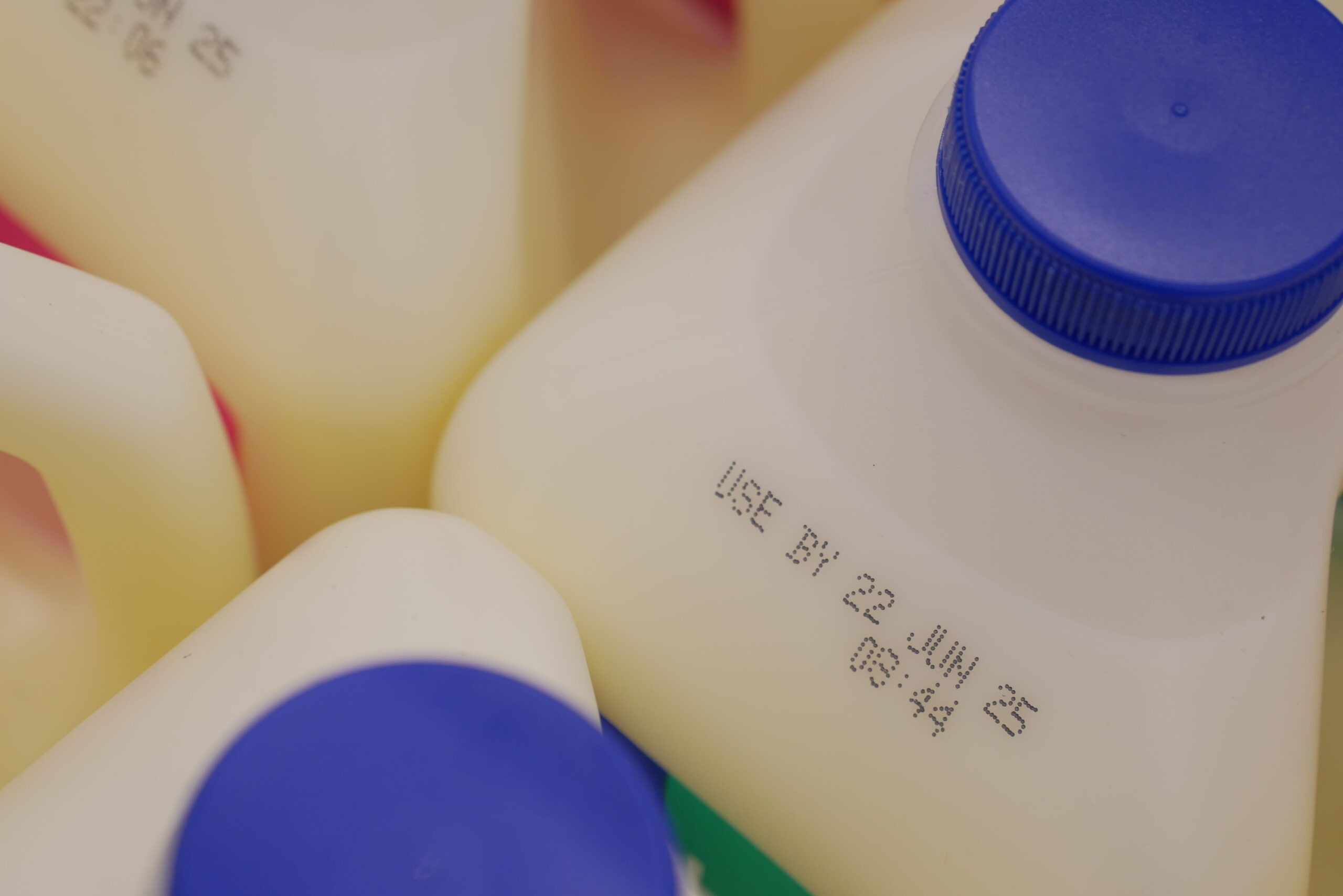
“Sell by” is a message to the retailer. It tells the grocery store how long to keep the product on the shelf. It says nothing about whether the food is safe to eat after that date.

“Best by” is about quality, not safety. It’s the manufacturer’s estimate of when the product will be at its peak flavor or texture. Neither is an expiration date. Neither means the food is bad.

Until Congress gets a uniform system across the finish line, consumers are largely left to navigate a confusing and inconsistent labeling landscape on their own. The labels weren’t designed with your grocery bill in mind. But your purchasing decisions are yours, and so is what goes in the bin.

Next time you reach for that carton of milk or block of cheese, take a second look. Think before the bin.

TweetShare
Stefanie Valentic

Stefanie Valentic

Stefanie Valentic is an award-winning journalist who has covered the waste and recycling industry for more than five years. Throughout her career, she has led editorial teams and served as a keynote speaker, moderator and panelist at numerous trade shows and conferences.

Related Posts

Top stories from March 2025

3 factors force e-scrap processing onshore

byDavid Daoud
June 19, 2026

EU and Southeast Asia regulatory environments and Gulf disruption are working together to impact the ITAD space.

College dorm room with boxes from moving day

What happens to college move out waste?

byIsabella Burke
June 19, 2026

The regular turnover in student housing can leave big piles of trash, but there are solutions in place for at...

Auto Draft

Reworld reports increased e-scrap volumes

byPaul Lane
June 18, 2026

The New Jersey-based company separated and processed 6,000 tons of metals from discarded electronics at its Philadelphia EcoWorld facility.

Compliance push drives new Republic organics facility

byStefanie Valentic
June 18, 2026

Republic Services started construction on a 140-acre organics facility in San Bernardino designed to expand Southern California's composting capacity under...

ICIS monthly recycled plastics pulse: Most Oct resin prices stabilize for fall

CA advances PET payments bill, posts DRS recovery rates

byAntoinette Smith
June 18, 2026

A California bill to increase payments to in-state PET reclaimers passed unanimously out of the Senate Environmental Quality Committee this...

Novelis posts steady Q2 amid tariffs, fire recovery

Tariff updates unlikely to have big impact on recycling industry

byPaul Lane
June 18, 2026

Revisions under Section 232 would lower the tariffs on certain materials through 2027.

Load More
Next Post
Growth challenges drive M&A for packaging

Growth challenges drive M&A for packaging

More Posts

IT security driving plans, reshaping budgets

Study cuts projected AI server e-waste by 90%

June 16, 2026
Revised CA budget includes $200m for recycling

CAA files California program plan for SB 54

June 15, 2026
Group updates on UBC-sorting robot’s success

Plastic bale pricing falls while paper, UBCs firm

June 15, 2026
Recycling council emphasizes importance of supply

Sorted: Why recycling isn’t a ‘scam’

June 15, 2026
Rare look inside the world’s largest plastics recycler

TRP launches fund to boost recycling

June 12, 2026
CAA seeks industry input on EPR fees

CAA seeks industry input on EPR fees

June 16, 2026
batteries

WM adds batteries to recycling watch list

June 16, 2026
A call to action: End markets and EPR

A call to action: End markets and EPR

June 16, 2026
ICIS monthly recycled plastics pulse: Most Oct resin prices stabilize for fall

CA advances PET payments bill, posts DRS recovery rates

June 18, 2026
Australia battery recycling sector could reach A$6.9bn by 2050

Colorado and California bills take aim at battery recycling gaps

June 12, 2026
Load More

About & Publications

About Us

Staff

Archive

Magazine

Work With Us

Advertise
Jobs
Contact
Terms and Privacy

Newsletter

Get the latest recycling news and analysis delivered to your inbox every week. Stay ahead on industry trends, policy updates, and insights from programs, processors, and innovators.

Subscribe

Welcome Back!

Login to your account below

Forgotten Password?

Retrieve your password

Please enter your username or email address to reset your password.

Log In

Add New Playlist

No Result
View All Result
  • The Latest
  • Analysis
  • Recycling
  • E-Scrap
  • Plastics
  • Policy Now
  • Conferences
    • E-Scrap Conference
    • Plastics Recycling Conference
    • Resource Recycling Conference
    • Textiles Recovery Summit
  • Magazine
  • About Us
  • Advertise
  • Archive
  • Jobs
  • Staff
Subscribe
This website uses cookies. By continuing to use this website you are giving consent to cookies being used. Visit our Privacy and Cookie Policy.