Resource Recycling
  • The Latest
  • Analysis
    • All
    • Certification Scorecard
    • Industry Announcements
    • Opinion
    NJ’s PCR delay risks making its own excuse permanently true

    NJ’s PCR delay risks making its own excuse permanently true

    E-scrap magnet recycling company scales up

    Why only some rare-earth sources are economically viable

    e-Stewards to develop an ITAD-specific standard

    Certification scorecard — week of Sept. 21

    Who should pay for lithium-ion battery fire damage?

    America’s critical-materials buildout has a feedstock problem

    Certification scorecard – week of Sept. 14

  • Conferences
    • Resource Recycling Conference
    • Plastics Recycling Conference
    • E-Scrap: The Longevity Conference
    • Textiles Recovery Summit
  • Publications
    • E-Scrap News
    • Plastics Recycling Update
    • Policy Now
    • Resource Recycling
    • Other Topics
      • All Topics
      • Brand Owners
      • Critical Minerals
      • Glass
      • Grant Watch / RFPs
      • Markets
      • Organics
      • Packaging
      • Research
      • Technology
      • Textiles
Subscribe
No Result
View All Result
Resource Recycling
No Result
View All Result
Home Recycling

How reuse fits into EPR

Brian Clark HowardbyBrian Clark Howard
May 6, 2026
in Plastics, Recycling
Person filling a bottle with product

Tigercat Lpg / Shutterstock

A trio of experts in the circularity space argued in a webinar Tuesday that reuse of consumer packaging can and should be part of extended producer responsibility (EPR) systems around the world.

“EPR is a policy approach that requires producers to take end-of-life responsibility for the product or packaging which is placed on the market,” said Isabelle Borkowski of consultancy Resource Recycling Systems, which hosted the webinar, titled “Beyond Recycling: EPR Meets Reuse.” 

Seven US states currently have EPR laws for packaging (California, Colorado, Maine, Maryland, Minnesota, Oregon and Washington) and a few more including New York are considering similar laws.

In order to achieve a truly sustainable future, reuse must be an important part of the solution, said Sydney Harris, policy director at the Upstream nonprofit. “A reuse economy,” she said during the webinar, “is at the base of a circular economy.

“We do that by normalizing reuse, growing and supporting the emerging reuse service industry and ensuring a supportive policy environment for reuse.”

EPR states

Reuse currently appears in all seven state EPR packaging laws, Harris said, but the specifics vary. In addition, the bipartisan REUSE Act was introduced in the US House of Representatives in February. 

“Maryland took a lot of reuse things out of their law,” she said. Oregon and Washington have grant programs to support reuse. Maine is allowing reusable packaging to be serviced through alternative collection programs, which can mean lower costs. There are also differences in how reuse is incentivized across states.

One critical incentive is that reusable packaging is assessed an EPR fee only the first time it is introduced, said Harris, so it isn’t penalized for repeat uses. That is the case in the Oregon and Minnesota laws but not Maryland, for instance. Harris said her team would also like to see clear definitions for reusable packaging.

Harris added, “The real bang for the buck, environmentally and economically, is returnable packaging. We strongly encourage everyone to be thinking not just foodservice and not just refillable, but returnable packaging.” She explained that in a refillable model, the consumer owns the packaging, although that’s not the case with returnable containers.

Reusable packaging needs to be collected and washed. Locating the wash centers near MRFs can reduce their footprint and allow for easy transfer of materials back and forth, if the wrong items are tossed into a cart, for example.

Beverages “are always number one” when it comes to reuse, said Harris, although she pointed out there is great potential for reuse in personal care, food service, household supplies and even small formats.

Learnings from France

During the webinar, Valentin Fournel, director of innovation, eco-design and reuse at French producer responsibility organization (PRO) Citeo, talked about efforts to encourage reuse of packaging. 

France passed a law in 2020 that mandated that 10% of packaging used there by 2027 must be reused. On the road to that goal, Citeo must dedicate 5% of its contributions to development of reuse every year (about €50 million or $59 million per year).

In addition, the European Union’s Packaging and Packaging Waste Regulation (PPWR) requires 40% reuse by 2040, with a number of exemptions, including wine, spirits, milk and more.

Fournel said €120 million ($141 million) has been spent in the last three years on some 550 experimental reuse projects in France. A lot has been learned, he said. One important result is movement toward standardization of packaging forms in the country, so there aren’t so many different forms to deal with. Another is the use of the color purple in labeling to signal that a package is reusable. Much thought is also going into collection and washing operations.

“We need to find a system that will work for everyone in the market,” said Fournel, who noted the biggest challenge remains the business model. Reusable packaging can cost more up front, causing resistance from the market. But over time costs should come down, he said, and eventually subsidies from PROs will no longer be needed.

Yet Harris said the reuse sector is growing, with “more reuse companies coming online every day” and a push toward standardization. A new reuse symbol is getting adopted. “Think of it like the chasing arrows symbol for recycling but far less fraught,” she said.

“Reuse is the future of packaging,” said Harris.

Tags: Conferences & EventsEPREuropePackaging
TweetShare
Brian Clark Howard

Brian Clark Howard

Brian Clark Howard is managing editor of Resource Recycling and an award-winning journalist with 25 years of experience. He is the co-author of several books and previously served as an editor and writer at The Hill, National Geographic, The Daily Green, E/The Environmental Magazine and The Daily Mail. He has covered a wide range of topics, from the environment to politics.

Related Posts

Oregon state capitol building with state flag and blue sky.

NAW appeals Oregon EPR ruling

byStefanie Valentic
September 25, 2026

NAW is challenging an Oregon judge's ruling in favor of the state's extended producer responsibility law.

Cutting healthcare plastics could save $18B

Report provides path to reduce medical e-scrap

byPaul Lane
September 25, 2026

The European report found that circularity in medical devices is possible through several potential initiatives.

Calif. Governor Gavin Newsom at podium.

Newsom signs battery EPR expansion, vetoes SB 54 fund bill

byStefanie Valentic
September 24, 2026

Newsom signed a battery EPR expansion and a nitrous oxide sales ban but vetoed a bill setting spending rules for...

E-scrap magnet recycling company scales up

Why only some rare-earth sources are economically viable

byDavid Daoud
September 24, 2026

Rare-earth recycling economics depend on several factors, and there is no single price or date that makes the process pencil...

Colorado’s EPR programs move from planning to practice

Colorado’s EPR programs move from planning to practice

byStefanie Valentic
September 17, 2026

Colorado's producer responsibility organizations move to implement the state's extended producer responsibility law.

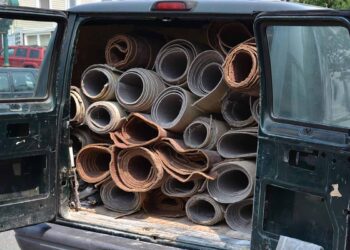
Van filled with rolled carpeting for recycling or disposal.

California carpet recycling rate reaches 37%

byBrian Clark Howard
September 17, 2026

The state’s recycling rate rose for the sixth year in a row, despite challenging market conditions.

Load More
Next Post

Origin Materials to shut down, sell PET cap design

2026 Buyers’ Guide

Equipment, services and technology suppliers serving the recycling industry.

Browse the Guide

More Posts

Apple store

Apple leads on inputs, faces questions on ITAD

May 1, 2026

In other news: May 2, 2016

May 2, 2016
The electronics recycling industry is undergoing a transformation from labor-intensive manual operations to highly automated, AI-driven facilities that use advanced robotics, cleaner chemistry and digital tracking systems to extract critical materials.

The cyber-physical MRF: AI and robotics reshape e-waste recovery

February 12, 2026
Textile EPR and the definition of recycling

Textile Exchange reports progress in production

September 22, 2026

America’s critical-materials buildout has a feedstock problem

September 18, 2026
Ten e-scrap projects receive federal prize funds

Recycling rates for rare earths could double by 2040

July 17, 2026
Data erasure firm expands wearable device capabilities

Apple hits 30% recycled content, debuts new recovery tech

April 17, 2026
Google sign on company building with blue sky and clouds above.

Inside Alphabet’s Q2 results: More capital spending and cloud backlog

July 28, 2026
Closeup of a printed circuitboard

Hardware demand puts new focus on parts harvesting

June 5, 2026
Battery recycler Ascend Elements files for bankruptcy

Battery recycler Ascend Elements files for bankruptcy

April 13, 2026
Load More

About & Publications

About Us

Staff

Archive

Magazines

Work With Us

Advertise
Jobs
Contact
Terms and Privacy

Newsletters

Get the latest recycling news and analysis delivered to your inbox every week. Stay ahead on industry trends, policy updates, and insights from programs, processors, and innovators.

Subscribe

Welcome Back!

Login to your account below

Forgotten Password?

Retrieve your password

Please enter your username or email address to reset your password.

Log In

Add New Playlist

No Result
View All Result
  • The Latest
  • Analysis
  • Recycling
  • E-Scrap
  • Plastics
  • Policy Now
  • Conferences
    • E-Scrap Conference
    • Plastics Recycling Conference
    • Resource Recycling Conference
    • Textiles Recovery Summit
  • Magazines
  • About Us
  • Advertise
  • Archive
  • Jobs
  • Staff
Subscribe
This website uses cookies. By continuing to use this website you are giving consent to cookies being used. Visit our Privacy and Cookie Policy.