


A running track heavily damaged during the 2025 Palisades Fire in Southern California is getting a second life instead of ending up in a landfill.
More than 140,000 pounds of rubber from the athletic track at Palisades Charter High School in Pacific Palisades will be recycled into pedestrian walkways for the Los Angeles Metro system, helping support infrastructure improvements ahead of the 2028 Olympic and Paralympic Games. The project highlights how disaster damaged materials can be recovered and reused through circular economy initiatives.
The track is being recycled by Ecore International, a Lancaster, Pennsylvania-based company that specializes in transforming reclaimed rubber into high performance surfacing. By recycling over 300 million pounds of truck tires annually, the company designs commercial and athletic flooring that reduces joint impact and absorbs sound, while offering take back programs to recycle their own products at end of life.
Thom Carmo, program manager of circularity at Ecore, said approximately 10% to 15% of the track material was damaged by the fire, rendering that portion hazardous and unsuitable for manufacturing new products. The remaining material, however, was successfully recovered.
Carmo said, “The material never left the local community. We took it out of Palisades, processed it in Fontana, and took it straight back to Los Angeles, where the same material was put right back into a pedestrian walkway project.”
Wildfire creates recycling challenge
The Palisades Fire burned more than 23,000 acres across Los Angeles County, destroying thousands of homes, schools and businesses while generating enormous amounts of debris during the recovery process.
Among the damaged facilities was an athletic running track that, under traditional disposal methods, likely would have been sent to a landfill.
Carmo said, “We were able to collect about 141,000 pounds of material from that track.”
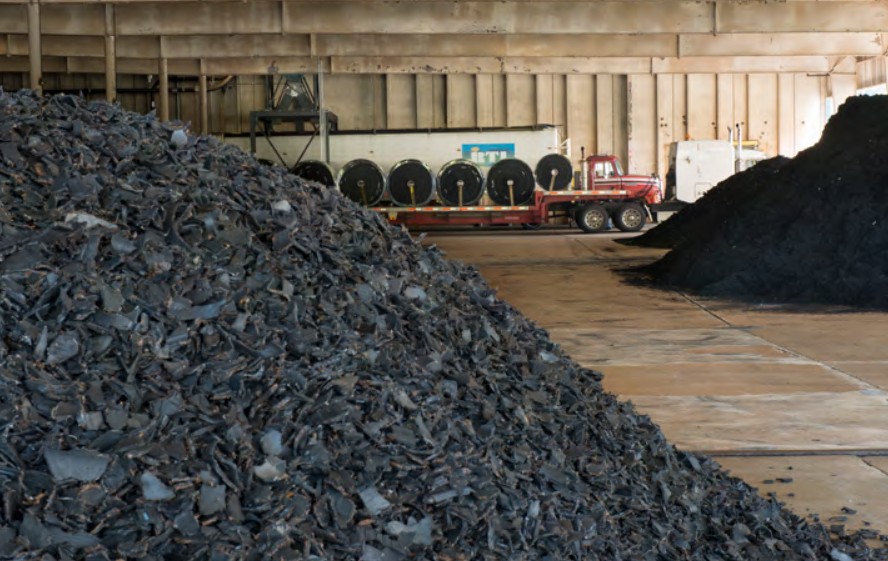
Unlike a typical demolition project, crews had to separate the burned and charred rubber from the reusable material before transporting eight dumpsters of salvaged track over three days to a recycling facility in Fontana, California.
Unlike many common construction materials, synthetic running tracks are made from rubber granules and specialty binders that make them difficult to process through conventional recycling systems. As a result, many aging or damaged tracks are disposed of at the end of their useful life.
Giving the material a second life
The recovered material was processed through Ecore’s recycling program with its recycling partner in Fontana, where the material was ground into progressively smaller pieces before being granulated into rubber pellets measuring roughly one-eighth to one-quarter inch.
The recycled rubber was then incorporated into material used for pedestrian walkways throughout the Los Angeles Metro system. The walkways are part of broader Los Angeles Metro improvements underway ahead of the 2028 Olympic and Paralympic Games.
“Nothing goes to the landfill when we take back a project. Even in the normal life cycle of a running track, we can take back that material and reuse it instead of sending it to the landfill,” Carmo said.
Carmo said even the fine rubber dust created during grinding is diverted from landfills and instead reused in asphalt applications or energy production.
Rather than becoming waste, the rubber will now help support public transportation infrastructure that will serve residents and visitors as Los Angeles prepares to host the 2028 Olympic and Paralympic Games.
A model for future recovery projects?
Carmo said projects like the Palisades track demonstrate how athletic surfaces can be recycled at the end of their service life instead of being disposed of, even after unexpected events such as wildfires.
As more communities replace aging athletic facilities and recover from climate-related disasters, he said projects like this could help keep valuable materials in circulation rather than sending them to landfills.
Carmo said, “We’d really like to find more and more projects like this one so that we can expand our footprint. Instead of the material ending up in a landfill, we’d prefer to regain that material and reuse it in other applications.”
One of the biggest lessons from the project, Carmo said, was the importance of involving recycling partners early in the planning process so reusable materials can be properly separated before demolition begins.
For communities rebuilding after disasters, Carmo said the project demonstrates that damaged materials do not always have to become waste. Instead, with proper planning and recovery efforts, they can become part of the next generation of public infrastructure.