




This article appeared in the December 2020 issue of Resource Recycling. Subscribe today for access to all print content.
Many industry conversations about recycling involve industry stakeholders debating costs, payments and administrative logistics. These are complicated discussions. The process involves political wrangling, specialist consultants and data analysis.
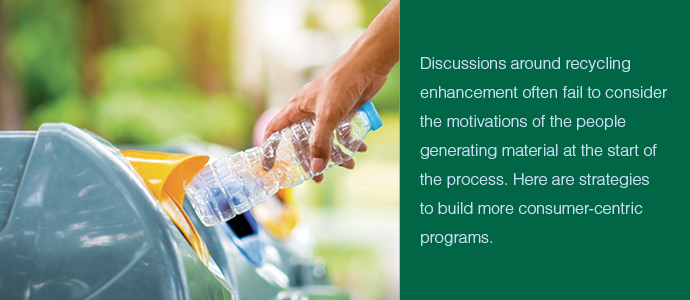
Too often, however, these conversations overlook an all-important consideration: How can we make recycling increasingly worthwhile for the consumer?
At the end of the day, recycling happens when the person in possession of used material makes a choice to divert it from the waste stream. If we want to increase recycling rates, we need to inspire consumers to change their behavior. Telling them to do so is not enough – we need to learn their motivations and goals and deliver solutions that satisfy their requirements.
In short, we need to deliver an excellent customer experience.
The company I work for, CLYNK, spends a lot of energy thinking about the customer experience of beverage container recycling, typically in the context of bottle bills. I’d like to share some insights we have gained on how to drive good customer experience. These strategies can be leveraged throughout the recycling industry – regardless of the specific details of the customer doing the recycling or the material that is being recycled.
A holistic cost-benefit analysis
Microeconomics 101 says that in order for someone to take an action (like recycling) the benefits must outweigh the costs. To apply this maxim to the most effect, it is important to take a holistic view of your customers’ ROI equation when designing a recycling program.
You’ll need to look closely at the customer’s experience at each stage of their recycling process and consider all of the benefits and all of the costs. Incomplete analysis of benefits and costs can obscure opportunities to improve customer experience and improve recycling rates.
Let’s look at a beverage container deposit example. If we view the consumer’s costs as only the deposit and their benefit as the refund, we are not seeing the whole picture. In reality, a consumer who is considering redeeming their can or bottle for refund incurs many “costs.”
They must spend time and effort to collect containers in their home. They need to transport them to a place where they can get refunded. Once there, they must take action to transact the redemption. Typically, this means handing the containers to someone to have them counted by hand or feeding the containers into a reverse vending machine themselves.
What is that customer experience like? Is the bottle redemption area clean? Is it loud? Is it safe? And how long do these transactions take?
Deposit programs typically consider convenience within a very narrow definition. Officials determine “access convenience” by analyzing drive times to redemption locations and often use “convenience zones” based on the geography of this access. Program rules cover customer experience basics such as signage and hours of operations, but they often fail to consider other important aspects of the customer experience.
Whether it’s time, thought, physical effort or discomfort, there are many obstacles that make container redemption very inconvenient, but program designs rarely promote “transactional convenience” for customers.
To drive increased recycling on all levels, we need to elevate the importance of transactional convenience and change the experience to be faster, easier and more pleasant for consumers. When considering access convenience, we need to look beyond the drive times and geography to consider factors like the value of “common stop locations” that do not require a trip to a separate facility.
The same is true of benefits. A holistic analysis of the benefits of recycling reveals new opportunities to drive more materials recovery.
It’s easy to focus on the financial rewards of recycling material (and this is certainly true for us in the container redemption space, where the value of refunds provides a very tangible incentive for customers to recycle). In reality, though, the benefits to customers of recycling extend well beyond financial rewards. They include non-financial benefits: a desire to protect the environment, to teach children stewardship and simply “to do the right thing.”
Program designs can and should leverage cost-effective strategies to enhance the psychological benefits of participation.
Finding ways to educate and celebrate
There are two main ways to increase the psychological benefits of recycling: education and celebration.
The value of education about recycling is well known and many recycling programs include an education component. Participation in recycling goes up when people better understand the positive externalities of their recycling behavior. In other words, when customers know that their recycling has positive impacts on external systems – be they the environment, the economy or something else – they are more likely to participate.
We certainly have seen the value of education in the beverage container redemption space. Specifically, we have found that educating consumers about the fact that container redemption programs provide exceptionally valuable, clean, food-grade recycled material has had a positive impact on customer participation.
Transaction history and activity reports are also a form of education. In the case of our company, this education is facilitated through a digital account. Digital account-based systems offer new opportunities to communicate and, in turn, new ways to enhance psychological benefits. Used effectively, these communication systems can transform the relationship between individual generators and recycling program operators.
Account-based recycling systems also open a new frontier for enhancing psychological benefits through the idea of celebration. At its most basic level, celebration is about recognizing the recycling activity of participants and sharing that recognition with them through communications. Therefore, key to celebration is a communication framework that allows the recycling operator to connect with individuals in a timely way.
A simple celebration communication might be a timely “thank you” coupled with a tangible measure of impact. “Thank you for recycling,” the message might state. “Your recycling saved enough carbon to power a lightbulb for 10 days.”
Celebration messages can also inspire education. For example, a simple “good job!” message might be coupled with links to educational materials. You can use the digital touchpoint to inspire the customer to explore details on how the material they recycled might be used.
Celebration messages let the generator know that their activity has been seen. They also have an implicit promise: “We are working together.”
Education and celebration can become even more engaging when paired with the concepts of gamification and badging.
Gamification can include the benchmarking of participation against oneself or against others. For example: “Congratulations! You recycled more last month than you ever have before.” If you have a Nest thermostat, you may have seen something similar with the Kudos Leaf Home Reports.
Badge value includes communications that connote status. One message we use is the following: “You have recycled 1,500 containers this year, and that puts you in the top 10%. You are a Super CLYNKer.”
We are experimenting and optimizing ways to enhance the psychological benefits and know that other programs are doing the same. The industry would be well served by the sharing of best practices in this area.
Right message, right person, right time
It is important to understand that individual motivations for recycling vary. In the case of beverage container recycling in bottle bill states, for example, some individuals are motivated almost entirely by the financial incentive, whereas others are motivated by the desire to “be green.”
Further, green motivations are nuanced. Some people care about reducing greenhouse gas emissions, others want to reduce ocean plastics, and others care most about other forms of litter. Most often, people are motivated by a mixture of these.
To maximize the effectiveness of our communications, it is important to recognize these differences and to provide different communications to different people. With the right data framework, it is possible to customize communications with the individuals in your program to speak to their specific motivations and interests. You can analyze engagement data and survey program participants to learn their high-level motivational profile and then tailor messaging to make it more relevant and valuable to them.
It’s also important to follow best practices to optimize the use of data. Data systems must allow customers to control the use of their information, including, but not limited to, how it will be used to customize the communications they receive.
Humans are emotional beings and emotional connections are an important driver of behavior change. By understanding individual customer goals and delivering the right messages to the right customers at the right time, we can deliver more value to customers and increase the emotional benefits of program participation.
By doing this consistently, we develop relationship equity with customers that drives high satisfaction, word-of-mouth referrals and program growth. We have seen firsthand the virtuous cycle effective communication can deliver toward generating more recycling and better recycling programs.
In step with wider trends
In this digital era of instant gratification, e-commerce and home delivery, it’s time for our industry to get serious about customer experience.
We need to modernize recycling programs to reduce the customer costs of time, effort and energy and increase the benefits with better communications to celebrate customers and present them with useful information about their recycling activities and impacts.
If you have examples on best practices in strong customer experience tied to recycling, please share.
Eric Winter is the senior manager of product marketing at CLYNK, a company that enhances material collection programs via its “bag drop” recycling system. He can be contacted at ewinter@clynk.com.