





Resource Recycling
  • The Latest
  • Analysis
    • All
    • Certification Scorecard
    • Industry Announcements
    • Opinion
    NJ’s PCR delay risks making its own excuse permanently true

    NJ’s PCR delay risks making its own excuse permanently true

    E-scrap magnet recycling company scales up

    Why only some rare-earth sources are economically viable

    e-Stewards to develop an ITAD-specific standard

    Certification scorecard — week of Sept. 21

    Who should pay for lithium-ion battery fire damage?

    America’s critical-materials buildout has a feedstock problem

    Certification scorecard – week of Sept. 14

  • Conferences
    • Resource Recycling Conference
    • Plastics Recycling Conference
    • E-Scrap: The Longevity Conference
    • Textiles Recovery Summit
  • Publications
    • E-Scrap News
    • Plastics Recycling Update
    • Policy Now
    • Resource Recycling
    • Other Topics
      • All Topics
      • Brand Owners
      • Critical Minerals
      • Glass
      • Grant Watch / RFPs
      • Markets
      • Organics
      • Packaging
      • Research
      • Technology
      • Textiles
Subscribe
No Result
View All Result
Resource Recycling
  • The Latest
  • Analysis
    • All
    • Certification Scorecard
    • Industry Announcements
    • Opinion
    NJ’s PCR delay risks making its own excuse permanently true

    NJ’s PCR delay risks making its own excuse permanently true

    E-scrap magnet recycling company scales up

    Why only some rare-earth sources are economically viable

    e-Stewards to develop an ITAD-specific standard

    Certification scorecard — week of Sept. 21

    Who should pay for lithium-ion battery fire damage?

    America’s critical-materials buildout has a feedstock problem

    Certification scorecard – week of Sept. 14

  • Conferences
    • Resource Recycling Conference
    • Plastics Recycling Conference
    • E-Scrap: The Longevity Conference
    • Textiles Recovery Summit
  • Publications
    • E-Scrap News
    • Plastics Recycling Update
    • Policy Now
    • Resource Recycling
    • Other Topics
      • All Topics
      • Brand Owners
      • Critical Minerals
      • Glass
      • Grant Watch / RFPs
      • Markets
      • Organics
      • Packaging
      • Research
      • Technology
      • Textiles
Subscribe
No Result
View All Result
Resource Recycling
No Result
View All Result
Home Resource Recycling Magazine

Looking at labor

byMark Mutton
August 9, 2023
in Resource Recycling Magazine

This article appeared in the July 2023 issue of Resource Recycling. Subscribe today for access to all print content.

We’re well into 2023, and although many economic indicators have shown resilience, we’re certainly not out of the woods yet when it comes to the global recession.

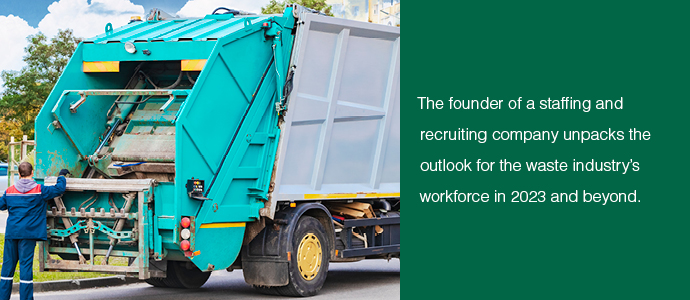
The waste industry has faced an interesting mix of headwinds and tailwinds in this regard, with an estimated 480,500 people employed in the sector as of the end of 2022 – a 3.85% increase year over year.

Quantitatively, this is a positive trend that points to a growing industry, but if you dig a little deeper, there are several widespread concerns about the quality of those jobs and their sustainability in light of other developing labor options.

Challenges facing the waste and recycling labor force

Three key challenges face the workforce in the waste industry, each of which is intertwined with one another – and all of which need to be addressed if the industry is to reach its potential this year.

First, despite inflationary pressure lifting wages in most sectors, the waste industry still lags in terms of wage growth, meaning that it’s difficult to attract personnel, especially when you consider what other options are out there. Without an adequate level of remuneration, it is very difficult to retain top talent who have many other options to choose from.

Another key aspect of the current labor market is that jobs are somewhat insecure and unstable. Waste and remediation projects can be short term in nature, and there is often significant employee churn as companies flex their labor forces up and down to meet demand.

This uncertainty will again harm the loyalty and satisfaction of workers who are not in control of their hours and job responsibilities.
Building on the above, the third key problem faced by the industry is poor conditions in the workplace. Working in waste is, by nature, a challenging proposition, but that does not mean that companies shouldn’t try to make working conditions as positive as possible. This includes company culture, work-life balance, health and safety, employee wellness and much more. Workers want to know that their employers care about them and when work conditions are poor, it throws that into question.

These challenges are serious, but they are solvable if the companies in the industry think differently about their hiring and general human resource relations – to change the paradigm and create a pleasant working experience across the board.

How should the industry address these challenges?

The proposed solutions for these challenges should not be surprising, but they are nonetheless key pillars that can make a big difference and create real change for individual companies and the industry as a whole.

First, whether companies like it or not, they are going to have to pay more for talent in the current labor market. A thorough compensation analysis should be conducted on a quarterly basis. Wages simply must be increased if the waste industry is going to be competitive for new entrants and retain the staff that are already in place. The inflationary pressures we’ve seen in the past few months necessitate a correction, and those companies that recognize this will be in a prime position to hire the next generation of talent into their organizations.

Another way to improve hiring and retention is to guarantee better job security for people who are entering the industry. Companies should be looking for ways to create truly full-time, long-term positions that can adapt and adjust to changing business circumstances without too much churn, which results in constantly having to rehire employees. The more you can ensure job security, the more candidates you’ll have to choose from when staffing your waste and remediation company.

Finally, companies should focus on improving the overall working conditions that employees are placed in on a day-to-day basis. Strategically, it makes a lot of sense to be proactive about this and go above and beyond what is expected to create an environment that fosters productivity, wellness and enjoyment among the entire workforce. Small touches that show employees they are cared for go a long way toward keeping them invested in the company’s mission.

These three components can be incredibly powerful if delivered in parallel. The investment required to make these changes happen might be significant, but it can be transformational if done right.

Where to from here?

The future of the waste and recycling labor force lies in the hands of the established companies that hold the keys to the kingdom. If the positive trends that we’ve been seeing are to continue, growth must be fed by higher wages, better job security and improved working conditions.

Companies that take these concepts seriously and build them into their strategic plans for 2023 and beyond will reap the rewards of these proactive moves and place themselves in the best possible position to attract and retain those key personnel to move their company forward.

Mark Mutton is the founder and CEO of recruiting and staffing company Inflection Poynt. He can be reached at inflectionpoynt.com/contact-us.

This article appeared in the July 2023 issue of Resource Recycling. Subscribe today for access to all print content.

TweetShare
Mark Mutton

Mark Mutton

Related Posts

Newsom nixes recycled content claims bill

Newsom nixes recycled content claims bill

byAntoinette Smith
September 28, 2026

Supporters of AB 2253 said the bill would address greenwashing, while opponents said it demonized mass-balance accounting and didn't reflect...

NJ’s PCR delay risks making its own excuse permanently true

NJ’s PCR delay risks making its own excuse permanently true

byEdward Kosior
September 28, 2026

In this editorial, Prof. Edward Kosior explores how policy uncertainty discourages investment and risks destroying existing recycling capacity.

trash bags

Sorted: Should we use recycled trash bags?

byBrian Clark Howard
September 28, 2026

Manufacturers’ resistance is rooted in performance and cost, but the products may have an important role to play.

Analysis: Undersupply of PCR is ‘stifling’ brand goals

US lawmakers urge protection of domestic RPET

byAntoinette Smith
September 25, 2026

In a letter to the US Trade Representative, five representatives asked the USTR to consider trade remedies and support verification...

Oregon state capitol building with state flag and blue sky.

NAW appeals Oregon EPR ruling

byStefanie Valentic
September 25, 2026

NAW is challenging an Oregon judge's ruling in favor of the state's extended producer responsibility law.

Cutting healthcare plastics could save $18B

Report provides path to reduce medical e-scrap

byPaul Lane
September 25, 2026

The European report found that circularity in medical devices is possible through several potential initiatives.

Load More
Next Post

Focusing on feedstock

2026 Buyers’ Guide

Equipment, services and technology suppliers serving the recycling industry.

Browse the Guide

More Posts

Oregon state capitol building with state flag and blue sky.

NAW appeals Oregon EPR ruling

September 25, 2026
Bin to Better gets students involved in reuse, recycling

Bin to Better gets students involved in reuse, recycling

September 24, 2026
Analysis: Undersupply of PCR is ‘stifling’ brand goals

US lawmakers urge protection of domestic RPET

September 25, 2026
Bipartisan reps introduce bill on recycling claims

House passes bill to ease lithium-ion battery storage rules

September 24, 2026
Calif. Governor Gavin Newsom at podium.

Newsom signs battery EPR expansion, vetoes SB 54 fund bill

September 24, 2026
Recyclers reeling from NJ PCR extension

Recyclers reeling from NJ PCR extension

September 23, 2026
Cutting healthcare plastics could save $18B

Report provides path to reduce medical e-scrap

September 25, 2026
Alpek closing Pennsylvania RPET plant

Alpek seizing on war-related opportunity 

July 27, 2026
Jeff Fielkow and the startup that’s building the US packaging EPR system

Jeff Fielkow and the startup that’s building the US packaging EPR system

September 10, 2026
E-scrap magnet recycling company scales up

Why only some rare-earth sources are economically viable

September 24, 2026
Load More

About & Publications

About Us

Staff

Archive

Magazines

Work With Us

Advertise
Jobs
Contact
Terms and Privacy

Newsletters

Get the latest recycling news and analysis delivered to your inbox every week. Stay ahead on industry trends, policy updates, and insights from programs, processors, and innovators.

Subscribe

Welcome Back!

Login to your account below

Forgotten Password?

Retrieve your password

Please enter your username or email address to reset your password.

Log In

Add New Playlist

No Result
View All Result
  • The Latest
  • Analysis
  • Recycling
  • E-Scrap
  • Plastics
  • Policy Now
  • Conferences
    • E-Scrap Conference
    • Plastics Recycling Conference
    • Resource Recycling Conference
    • Textiles Recovery Summit
  • Magazines
  • About Us
  • Advertise
  • Archive
  • Jobs
  • Staff
Subscribe
This website uses cookies. By continuing to use this website you are giving consent to cookies being used. Visit our Privacy and Cookie Policy.