






This article appeared in the September 2023 issue of Resource Recycling. Subscribe today for access to all print content.
As recycling technology and know-how have rapidly advanced over the past several decades, we’ve seen great leaps in the equipment used to identify, sort and process the various containers and materials found in the recycling stream. But one item has remained a stubborn thorn in the side of MRF operators: bottle caps. Now, equipment manufacturer TOMRA and recycling company Greenpath have joined forces to put a lid on this particular challenge.
“Developing a mechanical sorting process to close the loop for food-grade cap-to-cap recycling is groundbreaking. It’s a game changer to create a system to consistently separate mixed polyolefins by polymer and color with high purity,” said Joe Castro, president of Greenpath Enterprises in Colton, Calif.
The full-service recycler, processor and manufacturer has partnered with TOMRA Recycling Sorting to install and optimize a plastic flake sorting production line designed specifically to identify and separate mixed polyolefin caps from carbonated and non-carbonated beverage bottles. Greenpath’s vision is to create the same type of mature recycling system for bottle closures that exists for bottles themselves.
“We are at the genesis of creating a sorting system for caps similar to what is more common today for the bottle,” said Eric Olsson, area segment manager of plastics for TOMRA Recycling.
A focus on purity
Operating for more than 25 years with locations in California, Nevada and Texas, the vertically integrated Greenpath accepts a wide range of materials, and the flow of inbound materials can be somewhat inconsistent. However, this is where Castro sees the company’s advantage in offering value-added services. Greenpath creates value by serving as a one-stop solution for suppliers and customers alike by accepting mixed trailer loads with variable supply streams and producing consistent, quality products.
Greenpath’s expertise is its diverse plastic processing capabilities, but the company also accepts other recyclables as part of its complete service solution. Considering only the post-consumer polyolefin materials – low-density polyethylene (LDPE), high-density polyethylene (HDPE) and polypropylene (PP) – Greenpath accepts film, rigid plastics and of course bottle caps.
“Polypropylene and polyethylene are together the most abundant plastic family on earth, but the market is limited for valuable applications for mixed polyolefins,” Olsson said.
Unfortunately, polyethylene (PE) and PP have very close density characteristics and are challenging to separate into their different polymer types. That is why mixed polyolefins are primarily downcycled into more forgiving applications that allow for more contamination or a wider range of material specifications.
“Alternatively, other companies use a ‘solution by dilution’ approach to include mixed polyolefins, using primarily virgin material and only a small fraction of recycled plastic,” Castro noted.
With Greenpath’s focus on delivering value-added services to its customers, the polyolefin cap conundrum has kept Castro up at night for the last 15 years, when the company first started washing and processing recycled bottle caps. He had a vision for a sorting process solution to deliver high-quality, consistent separation of HDPE from PP to give brand owners and manufacturing companies the flexibility to confidently include post-consumer resin (PCR) material in their injection-molding applications. “We are ultimately targeting 98% or greater purity,” Castro said.
The quest for cap to cap
A beverage container commonly consists of four parts: the bottle, cap or closure, ring, and label. States with recycled content laws for bottles have seen packaging companies and recyclers take the first step by focusing on the PET bottle, which accounts for the bulk of the container’s weight. A more mature PET recycling infrastructure has led to brand owners incorporating up to 100% PCR in their bottles.
As regulations stiffen to increase the percentage of recycled content by weight, the next logical container component to address is the cap. “Following Greenpath’s approach, the industry can move toward a 100% PCR by weight package using only mechanical sortation,” Olsson said.
For a cap to get to a recycler such as Greenpath, a bottle must act as its carrier through the MRF. “Otherwise, the cap will get screened out in the front end of the circuit and more likely be landfilled,” Castro said.
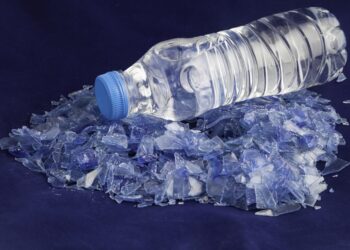
The bottles, labels, caps and rings are shredded, and a sink-float process is used to separate the PET bottles from the PE and PP caps. The heavier PET sinks while the lighter polyolefins float and are skimmed off as a secondary byproduct.
Logic may dictate using PET for both bottle and cap to solve the issue, but Olsson explains it’s not that simple. “Mono-material packaging is a dream that a lot of recyclers, brand owners and chemical companies are striving for, but we are not there yet. Different polymers have different strengths and weaknesses,” Olsson said. “Building in the threading on a cap that’s required to tighten and keep the container sealed is a property that polyolefins, PE and PP, lend themselves especially well too.”
Although some bottle recyclers see mixed polyolefins as waste, Castro sees them as an opportunity. Due to the company’s experience with the variety of materials and its philosophy of one-stop solutions for suppliers, Greenpath has extensive processing capabilities with different lines to sort diverse feedstock. The company is adept at mechanical, multimaterial and batch recycling processes.
To realize the opportunity to close the loop on caps and offer a more sustainable market for polyolefins, Greenpath investigated various technologies to sort the mixed polyolefins. “PE and PP densities are very close to one another, so using float-sink tanks is not effective,” Castro said.
Alternative recycling technologies were also considered but didn’t offer the yield or recovery for both PE and PP resins that was desired. According to Castro, the cost-benefit analysis just didn’t justify the space and capital required. “The yields are low, and you have to consider the expenditure, space and waste generated from the separation process,” he said.
Greenpath began to zero in on a mechanical solution using flake sorters. Company officials initiated conversations with TOMRA, who had introduced a new type of flake sorting technology. One of the technology’s design parameters was to extract value from multicomponent plastic waste streams.
Olsson mentioned that the industry hasn’t begun to reach the ceiling for mechanical polyolefin sorting. “It’s best to pursue a path that introduces the least amount of change to the material and sorts in the most efficient way,” he said. “Mechanical and chemical sorting technology OEMs are just getting the first processes off the ground to produce materials resulting from the 2025 and 2030 circularity commitments made in the twenty-teens. Producing 95% or greater purity-by-polymer streams is critical for many types of downstream recycling processes, and flake sorting can get us there.”
Flexibility in mechanical sorting
Discussions related to Greenpath’s goals led to the selection of TOMRA’s INNOSORT FLAKE sorter. One appealing feature for the company is that the sorter does not require a large footprint, allowing for easier integration at its Colton, Calif. facility. After discussing the purity, yield and throughput necessary to meet Greenpath’s objectives, flake sorters were installed.
Designed for flexibility, INNOSORT FLAKE incorporates a unique combination of sensor technologies, including color cameras capable of identifying 16.8 million color variations. With two-sided cameras, “one is positioned on each side of the chute where the materials fall through, so it can discern the difference between one side of the flake versus the other,” explained Eric Olsson, key account manager for TOMRA Recycling. This system helps to identify in-mold labeling that can be a contaminant. “Features like this cater the machine especially well to the polyolefin recycling supply chain, which is in dire need of quality gap closure,” he added.
The sorter’s “flying beam” lighting system offers fast and reliable material detection using near-infrared (NIR) sensors. Providing a homogeneous light distribution across the entire 2-meter machine width, the lighting system ensures proper classification of PE and PP materials, as well as other polymers and materials. Integrated into the scanner box for protection against damage, the illumination technology offers up to 80% energy savings over conventional light sensors.
 Configuration flexibility allows for single- or multiple-step sorting with the same unit. “We can split the machine into multiple sorting tasks by chute and even split a chute into two different process streams or more,” Olsson explained. “We can do multiple passes through a machine or link many machines in series to achieve the results we need.”
Castro admits the inconsistent feedstock Greenpath receives does present sorting challenges, but the company has been able to overcome these variations through years of experience to provide a good high-end recycled product. Still, the company ended up with a mixed polyolefin material. “TOMRA’s technology is allowing us to take the material to another level, to purify at a higher level that opens up the whole circular opportunity with going cap to cap,” he said.
Optimizing for consistency
The same thing that makes Greenpath an asset for its suppliers also makes it a hindrance to polyolefin flake sorting. The inconsistent feed has demanded special attention to the details of sorting optimization. This comes as no surprise, given that this is the first operation in North America to attempt this type of mixed polyolefin sorting. “These machines are themselves optimal in a steady-state stream,” Olsson said, “and thus have to work together as a holistic process system, along with other types of processing equipment.”
Both companies have been committed to getting the process right. “We shopped around for a company who would support us on this journey before selecting TOMRA. A manufacturer could just say, ‘You know the equipment and what it does, so go figure it out yourself,’” Castro said. “However, TOMRA has been very supportive in this project, and it has been more like a partnership and understanding that extra support would be needed to get the process right.”
Getting it right to meet Greenpath’s high purity goals of mono-polymer PE and PP from inconsistent mixed polyolefin feedstock has both parties analyzing the entire sorting process. While there is still some work to be done at the Colton facility, “mechanical viability is there,” Olsson confirmed.
The system is now to the point where the circuit can first sort by polymer using the INNOSORT FLAKE units, then it can sort by color. “If a customer wants a natural or specific sorted color such as red, white, blue, orange, or green PE or PP product, we can purify and provide them a sorted color that meets their specific application using PCR,” Castro said.
Olsson is optimistic about what has been accomplished with Greenpath, its impact on the mixed polyolefin market and what it means for packaging companies trying to meet recycled content targets. “We are just now starting to act on this opportunity,” he said. “We’re at the beginning for mixed waste streams of polyolefins going closed loop. It won’t just be a pipe dream for polyolefins anymore.”
Rick Zettler is the owner of Z-Comm LLC, a PR and marketing communications company that specializes in delivering coverage for its clients in the construction, road building, aggregate, mining and recycling industries. He can be reached at Rick@Z-CommPR.com.
For more information on the Greenpath project, visit greenpathrecovery.com or contact Joe Castro at (909) 954-0686.
This article appeared in the September 2023 issue of Resource Recycling. Subscribe today for access to all print content.