




Resource Recycling
  • The Latest
  • Analysis
    • All
    • Certification Scorecard
    • Industry Announcements
    • Opinion

    ITAD is moving past its adolescent phase: beyond end-of-life

    Rainforest

    Inside the Circle: What the rainforest can teach us about EPR

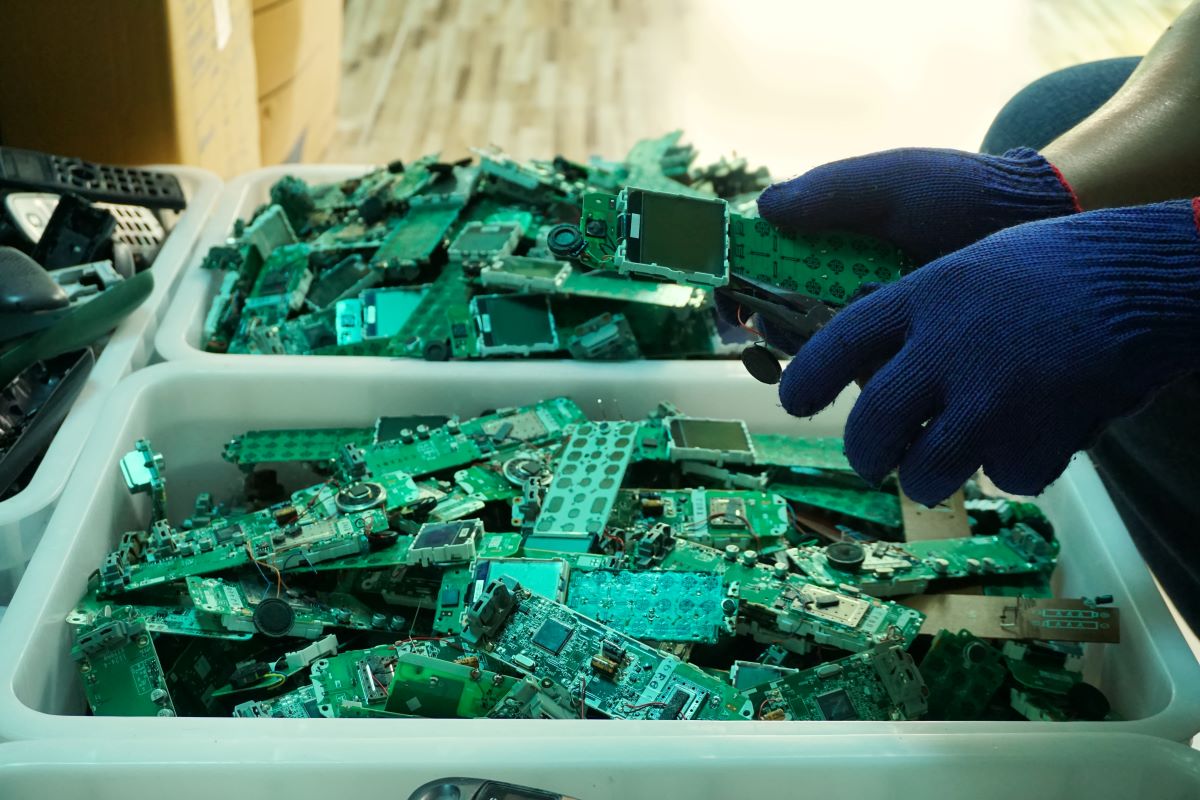
    Closeup of a printed circuitboard

    Hardware demand puts new focus on parts harvesting

    Rare look inside the world’s largest plastics recycler

    Mass balance matters: Why different rules can lead to different outcomes 

    Certification Scorecard — Week of June 1, 2026

    IT asset disposition and electronics recycling: Now and then

    $60 billion in AI servers will create an ITAD challenge

  • Conferences
    • Resource Recycling Conference
    • Plastics Recycling Conference
    • E-Scrap: The Longevity Conference
    • Textiles Recovery Summit
  • Publications
    • E-Scrap News
    • Plastics Recycling Update
    • Policy Now
    • Resource Recycling
    • Other Topics
      • All Topics
      • Brand Owners
      • Critical Minerals
      • Glass
      • Grant Watch / RFPs
      • Markets
      • Organics
      • Packaging
      • Research
      • Technology
      • Textiles
Subscribe
No Result
View All Result
Resource Recycling
  • The Latest
  • Analysis
    • All
    • Certification Scorecard
    • Industry Announcements
    • Opinion

    ITAD is moving past its adolescent phase: beyond end-of-life

    Rainforest

    Inside the Circle: What the rainforest can teach us about EPR

    Closeup of a printed circuitboard

    Hardware demand puts new focus on parts harvesting

    Rare look inside the world’s largest plastics recycler

    Mass balance matters: Why different rules can lead to different outcomes 

    Certification Scorecard — Week of June 1, 2026

    IT asset disposition and electronics recycling: Now and then

    $60 billion in AI servers will create an ITAD challenge

  • Conferences
    • Resource Recycling Conference
    • Plastics Recycling Conference
    • E-Scrap: The Longevity Conference
    • Textiles Recovery Summit
  • Publications
    • E-Scrap News
    • Plastics Recycling Update
    • Policy Now
    • Resource Recycling
    • Other Topics
      • All Topics
      • Brand Owners
      • Critical Minerals
      • Glass
      • Grant Watch / RFPs
      • Markets
      • Organics
      • Packaging
      • Research
      • Technology
      • Textiles
Subscribe
No Result
View All Result
Resource Recycling
No Result
View All Result
Home E-Scrap

Wearables are coming and ITAD isn’t ready

byDavid Daoud
April 16, 2026
in Analysis, E-Scrap
Apple Watch on product box.

Anastasia Desiana, Shutterstock

Over 600 million wearables shipped last year, representing the equivalent of smartphone-scale volume. And unlike phones, these devices are about to hit the disposition intake streams in waves. Available data suggests that the timeline is tight. 

Smartwatches and fitness bands refresh every 2–4 years. In the commercial sector, specifically in healthcare, clinical-grade monitors, the ones hospitals deploy in fleets, cycle even faster, every 1–3 years. These refresh cycles are already underway and will push significant end-of-life volume into the stream within 24–36 months.

The real problem is more about compliance, less about volume 

While most of the wearables in their current form are targeted to the consumer market, there is growing demand for commercial applications. And for ITAD companies, the opportunity may be less about hardware volume but more about the regulatory compliance and data security implications.

Hospitals and health systems in particular are now managing institution-sized fleets of patient-worn monitoring devices, from glucose sensors and cardiac monitors to remote patient monitoring patches. These devices collect continuous biometric data and connect directly to electronic health records. They enter and exit service on predictable refresh cycles. 

While the ITAD sector has not yet paid attention to this market, future volumes will likely generate recurring disposition events that savvy ITAD operators serving healthcare clients will encounter and with increasing frequency. 

A 2025 peer-reviewed study in NPJ Digital Medicine confirmed that modern wearables generate tens of thousands of individual data points per day per device. Across a hospital system retiring hundreds of devices per quarter, that is a significant data security surface that certified erasure protocols must cover. 

The FTC already tightened the Health Breach Notification Rule (July 2024) to cover fitness trackers and wearable health apps outside traditional HIPAA scope. And Senator Bill Cassidy’s Health Information Privacy Reform Act, introduced November 2025 and currently in committee, would extend HIPAA-comparable privacy, security and breach notification protections to wearable-derived health data (heart rate, skin temp, sleep patterns) collected by apps and devices outside traditional HIPAA coverage.

For end-of-life industry stakeholders, engaging in this market starts with their disposition protocols for wearables needing certified data erasure and compliance reporting comparable to enterprise IT assets. The devices are smaller and harder to process, yet the regulatory bar is higher.

The camera problem

Then there’s smart glasses. Leaders in that industry have major goals in the sector. Meta has already sold over 9 million Ray-Ban smart glasses since late 2023, with production capacity scaling to 10 million units per year. Apple is reportedly targeting a 2027 launch. And Google’s back in the game with Warby Parker. All three are converging on AI-enabled eyewear with cameras and mics.

And when the devices are capable of capturing images and audio in public spaces, they are expected to face end-of-life scrutiny beyond standard data erasure. FDA guidance is tightening as state privacy laws are also expanding. Camera-equipped wearables will arrive within 18 months.

In the current market environment, ITAD companies handling IT equipment decommissioning are ill equipped to handle this new market. But for those interested, the first step is to audit their battery handling. Wearables are universally built with embedded lithium-ion batteries, while screens are bonded and cases are glued. Safe processing requires careful disassembly protocols and battery chemistry management across form factors that vary widely.

In addition, more attention on documenting chain of custody is critical. Compliance-sensitive commercial clients, such as healthcare, will demand it.  

For ITADs that already have strong relations with target clients, the path ahead is easier. They’re already managing fleet retirement cycles. Early movers can establish recurring disposition partnerships before the volume spike hits.

All in all, the EOL sector should brace and prepare for density. While wearables are small, we expect volumes to be massive. The EOL industry’s intake and processing workflows need to account for throughput at scale. 

Tags: ElectronicsTechnology
TweetShare
David Daoud

David Daoud

David Daoud is a contributor to Resource Recycling and E-Scrap News, covering IT asset disposition, electronics recycling, and circular IT governance. He is the founder of and current Principal Analyst at Compliance Standards LLC, where he conducts independent research and advisory work on ITAD markets, sustainability and ESG compliance, data security, and lifecycle risk management. Daoud has analyzed enterprise IT trends since the late 1990s and was among the first analysts to examine ITAD as a distinct market segment during his time at IDC. He advises operators, OEMs, and investment teams on regulatory, technology, and market developments affecting the electronics lifecycle.

Related Posts

ITAD is moving past its adolescent phase: beyond end-of-life

byDavid Daoud
June 10, 2026

Some leading providers are starting to treat AI-era hardware, lifecycle data and sustainable IT strategy as part of a single,...

Battery fires still a major risk to recyclers: report

byPaul Lane
June 9, 2026

The June fire report from Ryan Fogelman shows there were 40 incidents in May at facilities in the United States...

GP Recycling offers on-ramp for smaller recyclers

GP Recycling offers on-ramp for smaller recyclers

byAntoinette Smith
June 9, 2026

The company's hubbIT platform is a way for smaller generators to sell plastic, glass and metal bottles to the brokerage,...

How electronics legislation fared this legislative season

NY sends repairability labeling bill to governor

byPaul Lane
June 8, 2026

New York would become the first state in the US with an electronic device repairability labeling requirement law.

DOE commits federal funds toward critical minerals

ABTC wins DOE appeal for Tonopah Flats lithium refinery project

byStefanie Valentic
June 8, 2026

ABTC has won back a DOE grant that was among hundreds terminated last fall.

Rare earth processor lands $5.1M in Defense funds

IonicRE partnership supports recycled rare earth supply chain for defense magnets

byIsabella Burke
June 8, 2026

The Australian company is joining with Florida-based Advanced Magnet Lab in a new MOU.

Load More
Next Post

AI surge, dealmaking reshape  ITAD industry 

More Posts

Recycling industry addresses Beyond Plastics report

Recycling industry addresses Beyond Plastics report

May 26, 2026
Fire at an EMR recycling facility in Camden, New Jersey May 29, 2026.

EMR faces shutdown calls after numerous fires

June 2, 2026
House resolution aims to make recyclability central to product design

NY EPR bill fails to advance after third try

June 8, 2026
IT asset disposition and electronics recycling: Now and then

$60 billion in AI servers will create an ITAD challenge

June 3, 2026
CalRecycle withdraws proposed regs for SB 54

Oceana, NRDC, CAW sue CalRecycle over SB 54 regs

June 5, 2026
The independent ITAD at a crossroads

DMD acquires ITAD firm Lifespan, outlines acquisition strategy

June 2, 2026
Our top stories from June 2021

Colorado advances EV battery EPR law

June 3, 2026
In My Opinion: Comparing the nation’s first packaging EPR laws

What Maine’s vape EPR law means for recyclers

June 4, 2026
Circular Materials to supply PlasCred chem recycling plant

Circular Materials to supply PlasCred chem recycling plant

June 4, 2026
Rare look inside the world’s largest plastics recycler

Mass balance matters: Why different rules can lead to different outcomes 

June 5, 2026
Load More

About & Publications

About Us

Staff

Archive

Magazine

Work With Us

Advertise
Jobs
Contact
Terms and Privacy

Newsletter

Get the latest recycling news and analysis delivered to your inbox every week. Stay ahead on industry trends, policy updates, and insights from programs, processors, and innovators.

Subscribe

Welcome Back!

Login to your account below

Forgotten Password?

Retrieve your password

Please enter your username or email address to reset your password.

Log In

Add New Playlist

No Result
View All Result
  • The Latest
  • Analysis
  • Recycling
  • E-Scrap
  • Plastics
  • Policy Now
  • Conferences
    • E-Scrap Conference
    • Plastics Recycling Conference
    • Resource Recycling Conference
    • Textiles Recovery Summit
  • Magazine
  • About Us
  • Advertise
  • Archive
  • Jobs
  • Staff
Subscribe
This website uses cookies. By continuing to use this website you are giving consent to cookies being used. Visit our Privacy and Cookie Policy.