Resource Recycling
  • The Latest
  • Analysis
    • All
    • Certification Scorecard
    • Industry Announcements
    • Opinion
    NJ’s PCR delay risks making its own excuse permanently true

    NJ’s PCR delay risks making its own excuse permanently true

    E-scrap magnet recycling company scales up

    Why only some rare-earth sources are economically viable

    e-Stewards to develop an ITAD-specific standard

    Certification scorecard — week of Sept. 21

    Who should pay for lithium-ion battery fire damage?

    America’s critical-materials buildout has a feedstock problem

    Certification scorecard – week of Sept. 14

  • Conferences
    • Resource Recycling Conference
    • Plastics Recycling Conference
    • E-Scrap: The Longevity Conference
    • Textiles Recovery Summit
  • Publications
    • E-Scrap News
    • Plastics Recycling Update
    • Policy Now
    • Resource Recycling
    • Other Topics
      • All Topics
      • Brand Owners
      • Critical Minerals
      • Glass
      • Grant Watch / RFPs
      • Markets
      • Organics
      • Packaging
      • Research
      • Technology
      • Textiles
Subscribe
No Result
View All Result
Resource Recycling
No Result
View All Result
Home Recycling

Oregon bottle deposit to grow to 10 cents

byJared Paben
July 26, 2016
in Recycling

Oregon, the first state to launch a beverage container deposit program, will also be the first in the U.S. to increase its deposit amount.North Portland Bottle Drop
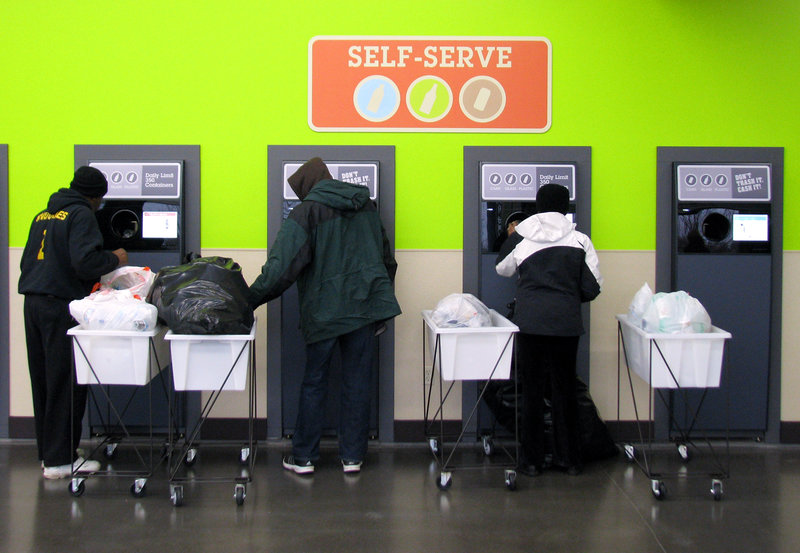
The Beaver State will boost its 5-cent deposit to 10 cents starting April 1, 2017, according to the Oregon Liquor Control Commission (OLCC). Under state law, the hike was triggered because Oregon experienced two consecutive years in which the redemption rate came in below 80 percent. OLCC, a state agency, oversees Oregon’s redemption program.

The 2015 redemption rate was 64.5 percent, and the 2014 rate was 68.3 percent, according to the OLCC.

The Oregon increase to 10 cents has been expected since last year. Last week’s announcement made the move official and set the 2017 implementation date.

Started in 1972, Oregon’s bottle bill today includes a variety of drinks in containers holding three liters or less, including carbonated soft drinks, waters and malt beverages. In 2018, juices, teas, coffees and sport drinks will be added to the program, although wine, liquor and milk drinks will still be excluded.

The Oregon Beverage Recycling Cooperative (OBRC), the industry group managing the vast majority of the state’s container redemptions, expects the 10-cent deposit to increase redemptions. But officials at the cooperative say quantifying the change is difficult.

“It’s anybody’s educated guess what might happen,” said Cherilyn Bertges, OBRC public relations and outreach manager. “We’re expecting an increase in volume. We are teaming up with the grocers that are still accepting containers to handle the volume as best as possible. We’re really committed to trying to educate the public on when this change is coming and making sure that everyone gets their deposit back.”

Historically, Oregon has relied on retail redemptions to return deposits. Over the past several years, however, OBRC, after receiving the go-ahead from state lawmakers, has been rolling out standalone BottleDrop Redemption Centers, which include newer redemption technologies. Grocery stores near the BottleDrop centers contribute to help pay for them but are no longer required by law to redeem large volumes of containers at their stores.

OBRC currently has 16 BottleDrop locations, and three more are expected to open before the deposit increases, Bertges said. OBRC has been opening about four BottleDrop locations per year and plans to continue that pace.

In 2015, 71 percent of aluminum cans, 68 percent of glass bottles and 52 percent of plastic bottles were redeemed, according to the OLCC. The plastics redemption rate reflects the addition of bottled water, often consumed outside the home.

Bertges said OBRC expects end-market demand to remain strong for the additional volumes of material collected. Aluminum collected by OBRC heads to smelters in the Midwest, largely to become new beverage cans. Glass is sent to O-I in Portland, Ore. to make bottles. And PET travels to the ORPET reclaimer in St. Helens, Ore. to produce flake. OBRC helped start and is a partner in the ORPET facility.

Michigan is the only state with a 10-cent deposit across a wide swath of container types, although California places a 10-cent deposit on containers holding 24 ounces or more. Oregon’s other neighboring states of Washington, Idaho and Nevada lack deposit programs.


Tags: Container DepositsGlassLegislation & EnforcementMarkets
TweetShare
Jared Paben

Jared Paben

Related Posts

Newsom nixes recycled content claims bill

Newsom nixes recycled content claims bill

byAntoinette Smith
September 28, 2026

Supporters of AB 2253 said the bill would address greenwashing, while opponents said it demonized mass-balance accounting and didn't reflect...

NJ’s PCR delay risks making its own excuse permanently true

NJ’s PCR delay risks making its own excuse permanently true

byEdward Kosior
September 28, 2026

In this editorial, Prof. Edward Kosior explores how policy uncertainty discourages investment and risks destroying existing recycling capacity.

trash bags

Sorted: Should we use recycled trash bags?

byBrian Clark Howard
September 28, 2026

Manufacturers’ resistance is rooted in performance and cost, but the products may have an important role to play.

Analysis: Undersupply of PCR is ‘stifling’ brand goals

US lawmakers urge protection of domestic RPET

byAntoinette Smith
September 25, 2026

In a letter to the US Trade Representative, five representatives asked the USTR to consider trade remedies and support verification...

Oregon state capitol building with state flag and blue sky.

NAW appeals Oregon EPR ruling

byStefanie Valentic
September 25, 2026

NAW is challenging an Oregon judge's ruling in favor of the state's extended producer responsibility law.

Bipartisan reps introduce bill on recycling claims

House passes bill to ease lithium-ion battery storage rules

byStefanie Valentic
September 24, 2026

The BRACE Act would let lithium-ion battery recyclers store batteries on site under universal waste rules and give EPA 18...

Load More
Next Post

Breaking it down: The latest plastics-to-fuel news

2026 Buyers’ Guide

Equipment, services and technology suppliers serving the recycling industry.

Browse the Guide

More Posts

Ten e-scrap projects receive federal prize funds

Recycling rates for rare earths could double by 2040

July 17, 2026
Intel sign outside of company building.

Intel’s CapEx tops $20B on server demand while PC volume shrinks

July 29, 2026
Feds to develop repairable computer donation program

The whitebox blind spot in PC recycling

April 24, 2026
Textile EPR and the definition of recycling

Textile Exchange reports progress in production

September 22, 2026

America’s critical-materials buildout has a feedstock problem

September 18, 2026

Microsoft confirms PC sales slump

August 4, 2026
Data erasure firm expands wearable device capabilities

Apple hits 30% recycled content, debuts new recovery tech

April 17, 2026

In other news: May 2, 2016

May 2, 2016
Closeup of a printed circuitboard

Hardware demand puts new focus on parts harvesting

June 5, 2026
The electronics recycling industry is undergoing a transformation from labor-intensive manual operations to highly automated, AI-driven facilities that use advanced robotics, cleaner chemistry and digital tracking systems to extract critical materials.

The cyber-physical MRF: AI and robotics reshape e-waste recovery

February 12, 2026
Load More

About & Publications

About Us

Staff

Archive

Magazines

Work With Us

Advertise
Jobs
Contact
Terms and Privacy

Newsletters

Get the latest recycling news and analysis delivered to your inbox every week. Stay ahead on industry trends, policy updates, and insights from programs, processors, and innovators.

Subscribe

Welcome Back!

Login to your account below

Forgotten Password?

Retrieve your password

Please enter your username or email address to reset your password.

Log In

Add New Playlist

No Result
View All Result
  • The Latest
  • Analysis
  • Recycling
  • E-Scrap
  • Plastics
  • Policy Now
  • Conferences
    • E-Scrap Conference
    • Plastics Recycling Conference
    • Resource Recycling Conference
    • Textiles Recovery Summit
  • Magazines
  • About Us
  • Advertise
  • Archive
  • Jobs
  • Staff
Subscribe
This website uses cookies. By continuing to use this website you are giving consent to cookies being used. Visit our Privacy and Cookie Policy.
-
00:00
00:00

Queue

Update Required Flash plugin
-
00:00
00:00