





Your monthly guide to understanding the recycling system — no jargon, no guilt, just clear answers to the questions everyone has but rarely asks. From how materials markets work to what “wishful recycling” actually costs, Sorted makes the industry make sense.
Editor’s Note: Textile recovery implementation will be featured in sessions at the 2027 Textile Recovery Summit, Mar 1-3 near Washington, D.C. Register now!
Imagine filling a trash bag with clothes you no longer wear, dropping it in one of those collection bins in a parking lot somewhere and driving away feeling like it’s going to go to someone in need.
Here’s what nobody tells you: That bag is almost certainly headed to another country.
The US largely doesn’t sort the clothing it collects. Charities act as collectors. They accept donations, bale them up and sell them to overseas sorting facilities, says Dr. Iva Jestratijevic, associate professor of merchandising and digital retailing at the University of North Texas.
The US is the world’s largest exporter of used clothing, shipping more than $1 billion worth overseas in 2022 alone, according to UN Comtrade data. Pakistan and the UAE are the top destinations, functioning as global sorting hubs where baled donations are processed and redistributed to secondary markets across Africa and Asia.
The revenue funds their charitable missions, and the garments become part of a global secondhand trade that is under more pressure than it’s been in years as consumption continues to rise.
The fashion industry produces 100 billion to 150 billion garments annually. Thirty percent are never sold. They go straight from production to dead stock, never reaching a consumer at all. The ones that do get worn end up in donation bins, thrift stores or a residential waste bin, and the US has almost no infrastructure to handle any of it.
The EPA’s most recent textile waste data is from 2018, almost a decade old. Only two countries in the world, France and the Netherlands, have active extended producer responsibility (EPR) programs for textiles. In the US, California recently passed the nation’s first textile waste recovery legislation.
Donate… or do not?
If you’ve been following the secondhand market or thrifting, the picture has gotten more complicated over the years.
The global export system that absorbed American cast-offs for decades is slowing down. Trade pressures, import restrictions and the sheer volume of low-quality fast fashion items flooding the pipeline have strained the infrastructure the US donation model depends on.
And that slowdown has consequences. The assumption that donated clothing “goes somewhere useful” is harder to maintain when recovery systems don’t match the volumes of donated or unwanted clothing that is discarded.
“The problem is that many municipalities don’t recognize textile as a part of the solid waste system,” says Dr. Jestratijevic. “They don’t see the problem that textile waste creates that much…We don’t witness contamination or incineration in a local landfill. It’s very hard for us scientists to gather the data.”
Without data, there’s no case for legislation. Without a policy case, the infrastructure stays underfunded.
A $1,000 grant and a lot of pink bins
Just a few years ago, Dr. Jestratijevic didn’t set out to fix the national textile waste problem. She was trying to keep her students awake during COVID.
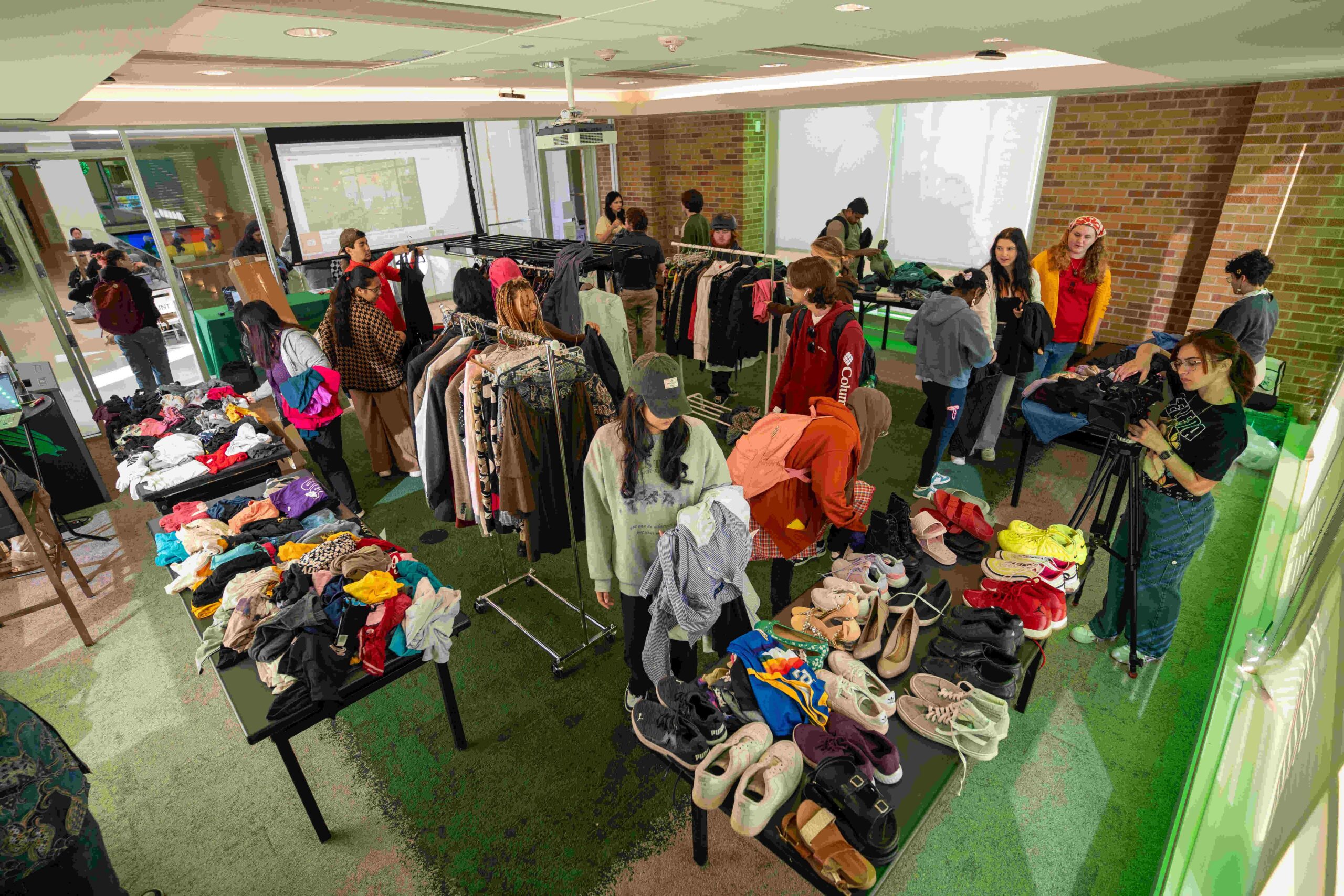
Classrooms were empty and motivation to attend was low. She had been researching sustainable fashion and circular economy for years, and she needed a project her students could actually interact with. In 2022, she came up with a process: collect unwanted clothing on campus, sort it, redistribute it and document everything.
She then applied for a $1,000 seed grant from STAR Recycling. With it, she bought bright pink rolling bins. She placed them across the University of North Texas campus because pink stands out, she says, and because students would not mistake them for trash cans.
The Zero Waste Textile Initiative officially launched March 4, 2024. And, within a two-year period, it has collected 9,515 pounds of textiles and apparel, diverted 6,804 pounds from landfill and achieved a 72% diversion rate. That’s more than 11,000 items of clothing. It has more than 200 student volunteers per semester and just received its first corporate grant from UNIQLO which sent a team of 10 from Tokyo to tour the lab.
“Within the two-year period, we were able to increase the sorting procedures’ efficiency by 5.4 times,” says Rosalyn Zuniga, the initiative’s project manager and a graduate student who has led operations since launch. “We started from a completely new system from pretty much ground zero.”
The numbers behind it
What makes the Zero Waste Textile Initiative different from a well-meaning campus donation drive is that it runs like a research project. Dr. Jestratijevic, who also consults for the European Environmental Protection Agency, built data collection into the model from the beginning.
“Unless you have data in the sustainability area, you cannot provide evidence even when you are applying for grants,” she says. “If you are collecting waste, you need to audit waste, you need to have the data to support your activities, and then to attract the funders.”
The initiative uses a triple impact assessment framework covering environmental, social and financial impacts while built on what’s called a life cycle assessment methodology developed for the secondhand retail market. A life cycle assessment studies the environmental impact of a product from the start to its end of life.
Over two years, the outcomes include more than 63,000 kilograms of CO2 equivalent avoided, 961,000 megajoules of primary energy saved, and more than 2 million liters of water conserved. Students and community partners received an estimated $74,000 worth of clothing, redistributed for free. The reuse rate was 96%.
And the social impact findings are worth noting. Eighty-four percent of survey respondents reported less stress over clothing-related costs. Seventy percent said they would have had difficulty affording clothing without the program.
“This just shows how much of a need this is on campuses,” Zuniga said. “And this is something that applies to every other campus in the country.”
Your closet has worth
One of the clearest messages from UNT’s work is that the clothing you’re ready to get rid of is worth more than our current waste system considers.
The initiative receives donations from sources most people wouldn’t expect. A manufacturer recently sent nearly 3,000 pounds of completely new overstock including new Patagonia jackets that would have otherwise gone to landfill. The Dallas Market Center donates interior textile scraps. A major winter apparel brand asked that logos could be covered so items could be redistributed rather than destroyed.
“To them it’s trash, it’s waste,” Zuniga says. “But to us it’s something we can reuse and give back to students.”
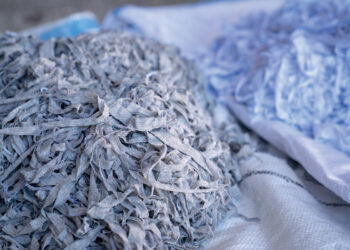
Design students at UNT also use the textile scraps for class projects, fabric journals, upcycled garments, art installations. The lab is scaling a dog bed prototype stuffed with shredded fabric and covered in denim. A local mending cafe teaches students and community members to repair clothing on the spot and go home with the skills to do it again.
Finding value in what others call waste turns out to be the foundation of an industry most consumers have never heard of.
Two reports published this spring examined the large-scale global reuse and recovery infrastructure for used clothing. Debrand’s FY2025 Transparency Report and a joint study on secondhand clothing markets in El Salvador found that the textile recovery industry is far more mature than most consumers, policymakers or brands realize even as newer textile-to-textile recycling technologies attract the bulk of headlines and investor attention.
Of the more than 2.5 million pounds Debrand diverted from landfills in FY2025, more than half went to fiber reclamation, or turned into industrial wiping cloths, insulation and other material inputs. Advanced recycling, the kind that breaks textiles down into new fiber, accounted for just over 1%.
“Fiber reclamation and shoddy production have been around for a long time and they’re an important part of the circular value chain,” says Marisa Adler, an independent consultant who contributed to the research, told Resource Recycling. “So is the reclaimed wiping cloth industry. Silent but hugely important.”
The infrastructure gap, Adler says, isn’t that the system doesn’t exist. It’s that no one is talking to it. Collectors, sorters, graders, brokers and recyclers have been managing used textiles for a century. The brands and policymakers now scrambling for circularity solutions often don’t know where to find them.
“Fashion or textiles are not to be discarded. This is a really beautiful source. We can use this source as input for many products, not just insulation and wiping devices, but it can generate energy. It can be used in many, many ways,” says Dr. Jestratijevic.
Think before the bin
So, what does this mean for the average person standing in front of a bag of clothes they no longer want?
Rethink the goal. Dropping clothing in a bin is a starting point, not a solution, so start by thinking about what donating actually accomplishes.
Consider repair first. A missing button is not a reason to throw a shirt away. A small hole does not make a jacket unwearable. UNT recently added a core life skills class that includes clothing mending to its curriculum.
Keep textiles local. Look for clothing swaps, mutual aid closets, university-based initiatives and community giveaway events. The UNT model is built to be replicated, and Dr. Jestratijevic is actively sharing the template with other universities.
“Very often they just discard a shirt or blazer because it’s missing one button,” Dr. Jestratijevic says. “These are very basic skills, and I think every kid should know how to do this.”
Consider the recipients. If you’re clearing out a larger volume of clothing, think about who’s actually going to use it and how. Programs that don’t require ID or proof of residency to access are putting that material directly back into the system. This method of distribution removes barriers to serving families, students and unhoused populations.
And if you’re curious where the policy is headed: EPR for textiles is gaining traction, Dr. Jestratijevic recently reviewed textile collection policy across EU member states. She says the US is a few years behind, but the secondhand market is growing three times faster than mainstream fashion, and pressure is growing for producers to take responsibility for what they make.
While the infrastructure to handle all of it isn’t here yet, the people building it are doing it bin by bin, one pound at a time.