




Resource Recycling
  • The Latest
  • Analysis
    • All
    • Certification Scorecard
    • Industry Announcements
    • Opinion
    NJ’s PCR delay risks making its own excuse permanently true

    NJ’s PCR delay risks making its own excuse permanently true

    E-scrap magnet recycling company scales up

    Why only some rare-earth sources are economically viable

    e-Stewards to develop an ITAD-specific standard

    Certification scorecard — week of Sept. 21

    Who should pay for lithium-ion battery fire damage?

    America’s critical-materials buildout has a feedstock problem

    Certification scorecard – week of Sept. 14

  • Conferences
    • Resource Recycling Conference
    • Plastics Recycling Conference
    • E-Scrap: The Longevity Conference
    • Textiles Recovery Summit
  • Publications
    • E-Scrap News
    • Plastics Recycling Update
    • Policy Now
    • Resource Recycling
    • Other Topics
      • All Topics
      • Brand Owners
      • Critical Minerals
      • Glass
      • Grant Watch / RFPs
      • Markets
      • Organics
      • Packaging
      • Research
      • Technology
      • Textiles
Subscribe
No Result
View All Result
Resource Recycling
  • The Latest
  • Analysis
    • All
    • Certification Scorecard
    • Industry Announcements
    • Opinion
    NJ’s PCR delay risks making its own excuse permanently true

    NJ’s PCR delay risks making its own excuse permanently true

    E-scrap magnet recycling company scales up

    Why only some rare-earth sources are economically viable

    e-Stewards to develop an ITAD-specific standard

    Certification scorecard — week of Sept. 21

    Who should pay for lithium-ion battery fire damage?

    America’s critical-materials buildout has a feedstock problem

    Certification scorecard – week of Sept. 14

  • Conferences
    • Resource Recycling Conference
    • Plastics Recycling Conference
    • E-Scrap: The Longevity Conference
    • Textiles Recovery Summit
  • Publications
    • E-Scrap News
    • Plastics Recycling Update
    • Policy Now
    • Resource Recycling
    • Other Topics
      • All Topics
      • Brand Owners
      • Critical Minerals
      • Glass
      • Grant Watch / RFPs
      • Markets
      • Organics
      • Packaging
      • Research
      • Technology
      • Textiles
Subscribe
No Result
View All Result
Resource Recycling
No Result
View All Result
Home E-Scrap

Researchers study health conditions at ITAD firm

byJared Paben
April 25, 2019
in E-Scrap
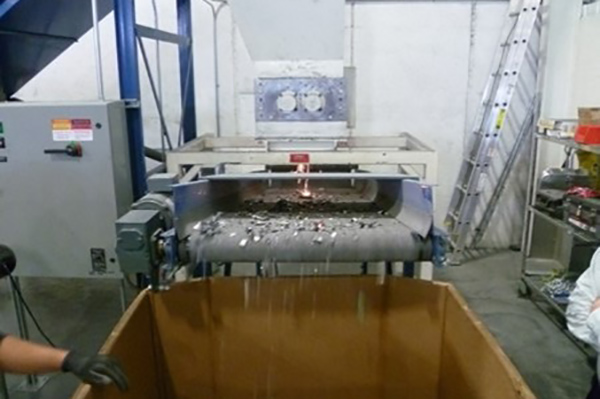
Sparks from shredding hard drives and material advancing down a conveyor to a collection box.

Scientists evaluated employee exposure to toxic metals and flame retardants at Cascade Asset Management. The results and their suggested fixes could help other electronics processors improve health and safety.

Researchers at the National Institute for Occupational Safety and Health (NIOSH) last month published the results of their study at the Madison, Wis.-based ITAD facility. Their report didn’t reveal the electronics processing facility, but Cascade confirmed in its newsletter the research was conducted at its headquarters processing facility. The assessment was done at the request of Cascade’s management.

“The results showed that maintaining good exposure controls, such as rigorous housekeeping, helps substantially to reduce employee exposure to hazards in the electronics recycling industry,” Catherine Beaucham, a scientist who helped lead the project, told E-Scrap News.

Environmental and biological samples

In February 2017, scientists collected surface wipe, hand wipe, air, blood and urine samples, as well as measured noise and observed employees working. Sample testing showed that while employees were exposed to metals including lead and cadmium, none had elevated levels of lead or cadmium in their blood. Additionally air sampling found no exposures to airborne metals over occupational exposure limits.

Hand wipe sampling, however, did demonstrate there’s the potential for employees to inadvertently take home contaminants. Noting that soap and water isn’t enough to remove toxic metals from hands, the researchers recommended Cascade provide employees with a specific lead-removing product. They also recommended that, instead of dry sweeping, employees clean their work areas with wet-cleaning methods or a high-efficiency vacuuming system. They recommended using a magnetic sweeper to pick up loose screws and other scrap metal.

As far as flame retardants were concerned, sample analysis confirmed that employees are exposed to them, but exposure levels were typically lower than what has been seen at other e-scrap recycling companies. The researchers noted that Cascade’s facility doesn’t do a substantial amount of mechanical disassembly.

The presence of flame retardants was not a surprise. A NIOSH report released a year ago showed workers at a different e-scrap facility were being exposed to flame retardants, and an Indiana University study published last fall showed e-scrap dust had increased levels of a particular flame retardant. Scientists recently studied ways employees can effectively remove flame retardants from their hands at the end of their shifts.

The science on flame retardants’ impacts on human health isn’t as mature as it is for materials such as lead. While numerous studies have shown an association between flame retardant exposure and some serious health problems, it’s not clear yet at what levels of exposure those impacts begin to occur, the researchers noted.

“Evaluations like this one help us identify populations with potential exposure and may help establish baseline levels to evaluate employees in at-risk industries during future research,” they wrote.

The experts also identified a number of work-station ergonomic concerns that could lead to employee injuries. Those included employees working in awkward postures, using forceful exertions, performing repetitive motions, standing for prolonged periods and working in sub-optimal lighting.

As a result, the company installed and retrofitted workbenches and equipment “to reduce unnecessary musculoskeletal strains over the past two years,” Cascade wrote.

Photo credit: NIOSH

 

Tags: Research
TweetShare
Jared Paben

Jared Paben

Related Posts

Canada seeks recycled-content mandates feedback

Building demand for recycled flexibles

byBrian Clark Howard
August 25, 2026

A new report from Delterra and Eunomia found that companies could readily create demand for up to 800,000 tons of...

Two pilot programs in CA recycle commercial film

byIsabella Burke
August 10, 2026

Two new pilot programs are testing different approaches to collecting and recycling commercial plastic film.

Europe’s recyclers miss most of the critical materials

Market surge expected for plastic from e-scrap

byPaul Lane
August 10, 2026

A report from QY Research found that market growth will likely be fueled by increased demand for recycled plastic, which...

Maximizing the value of post-consumer PP 

Maximizing the value of post-consumer PP 

byEdward Kosior
August 5, 2026

In a guest column, Dr. Kosior makes the case for tailoring recycled PP grades to specific applications to provide a...

Penn State professor Maryam Shahri speaks at the PROP conference in Lancaster, Pennsylvania July 23, 2026.

How to get more people to recycle

byBrian Clark Howard
July 24, 2026

Harness the power of behavioral marketing, panelists said at the PROP conference in Pennsylvania.

Federal funds boost critical mineral research efforts

Federal funds boost critical mineral research efforts

byPaul Lane
July 16, 2026

A Midwest consortium plans to use the money to build up domestic mineral recovery and processing efforts.

Load More
Next Post
Tvs on display for sale at a warehouse store.

EPEAT audits measure company compliance

2026 Buyers’ Guide

Equipment, services and technology suppliers serving the recycling industry.

Browse the Guide

More Posts

Oregon state capitol building with state flag and blue sky.

NAW appeals Oregon EPR ruling

September 25, 2026
Analysis: Undersupply of PCR is ‘stifling’ brand goals

US lawmakers urge protection of domestic RPET

September 25, 2026
Recyclers reeling from NJ PCR extension

Recyclers reeling from NJ PCR extension

September 23, 2026
Jeff Fielkow and the startup that’s building the US packaging EPR system

Jeff Fielkow and the startup that’s building the US packaging EPR system

September 10, 2026
Newsom nixes recycled content claims bill

Newsom nixes recycled content claims bill

September 28, 2026
Bipartisan reps introduce bill on recycling claims

House passes bill to ease lithium-ion battery storage rules

September 24, 2026
Spin-off lets Linca focus on battery mineral recovery

Critical mineral policy shift creates opportunity

September 14, 2026
Calif. Governor Gavin Newsom at podium.

Newsom signs battery EPR expansion, vetoes SB 54 fund bill

September 24, 2026
New Jersey pushes back PCR mandate to 2030

New Jersey pushes back PCR mandate to 2030

September 10, 2026
trash bags

Sorted: Should we use recycled trash bags?

September 28, 2026
Load More

About & Publications

About Us

Staff

Archive

Magazines

Work With Us

Advertise
Jobs
Contact
Terms and Privacy

Newsletters

Get the latest recycling news and analysis delivered to your inbox every week. Stay ahead on industry trends, policy updates, and insights from programs, processors, and innovators.

Subscribe

Welcome Back!

Login to your account below

Forgotten Password?

Retrieve your password

Please enter your username or email address to reset your password.

Log In

Add New Playlist

No Result
View All Result
  • The Latest
  • Analysis
  • Recycling
  • E-Scrap
  • Plastics
  • Policy Now
  • Conferences
    • E-Scrap Conference
    • Plastics Recycling Conference
    • Resource Recycling Conference
    • Textiles Recovery Summit
  • Magazines
  • About Us
  • Advertise
  • Archive
  • Jobs
  • Staff
Subscribe
This website uses cookies. By continuing to use this website you are giving consent to cookies being used. Visit our Privacy and Cookie Policy.