Resource Recycling
  • The Latest
  • Analysis
    • All
    • Certification Scorecard
    • Industry Announcements
    • Opinion
    NJ’s PCR delay risks making its own excuse permanently true

    NJ’s PCR delay risks making its own excuse permanently true

    E-scrap magnet recycling company scales up

    Why only some rare-earth sources are economically viable

    e-Stewards to develop an ITAD-specific standard

    Certification scorecard — week of Sept. 21

    Who should pay for lithium-ion battery fire damage?

    America’s critical-materials buildout has a feedstock problem

    Certification scorecard – week of Sept. 14

  • Conferences
    • Resource Recycling Conference
    • Plastics Recycling Conference
    • E-Scrap: The Longevity Conference
    • Textiles Recovery Summit
  • Publications
    • E-Scrap News
    • Plastics Recycling Update
    • Policy Now
    • Resource Recycling
    • Other Topics
      • All Topics
      • Brand Owners
      • Critical Minerals
      • Glass
      • Grant Watch / RFPs
      • Markets
      • Organics
      • Packaging
      • Research
      • Technology
      • Textiles
Subscribe
No Result
View All Result
Resource Recycling
No Result
View All Result
Home Analysis

Europe pulls ahead on ITAD now while US growth remains slower

byDavid Daoud
January 28, 2026
in Analysis, E-Scrap
New entrepreneurs bring renewed energy to e-cycling

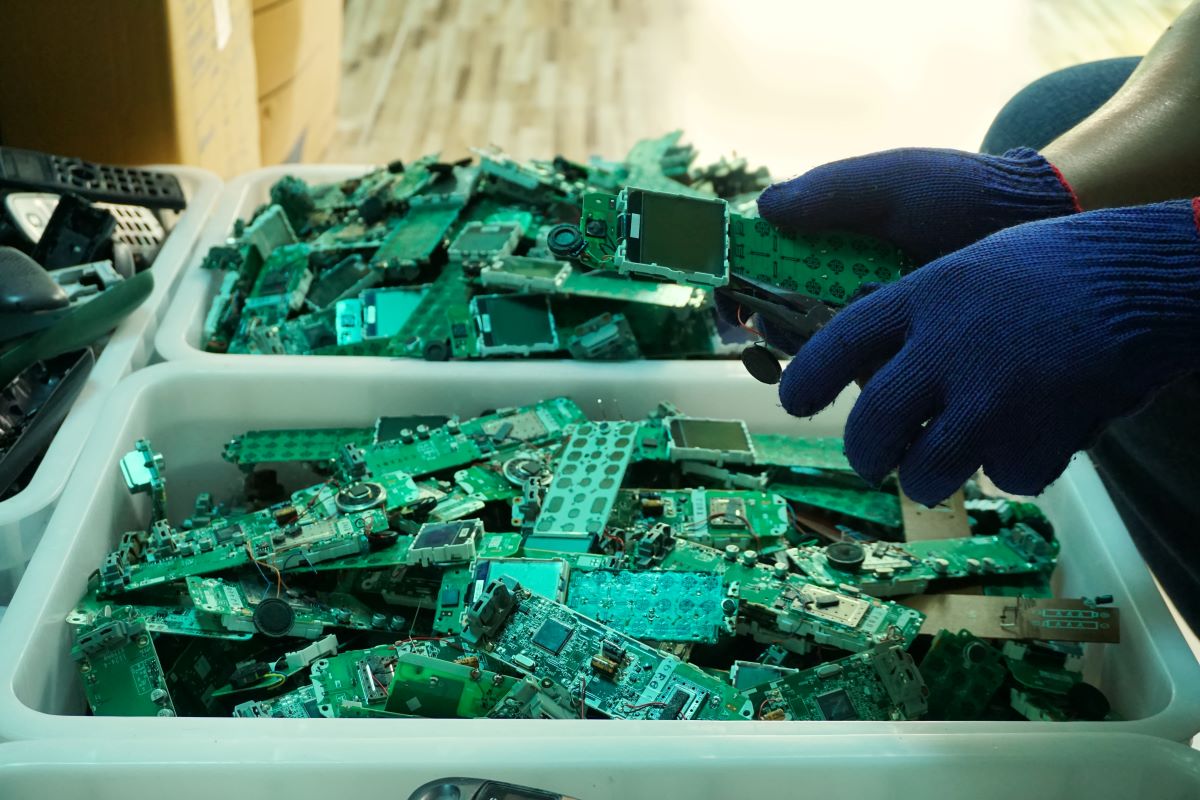
Early 2026 shows Europe accelerating IT asset disposition investment through facilities, acquisitions and regulation, while US ITAD growth continues in a more incremental model. | RATTANAPONG/shutterstock

Early 2026 shows evidence of a widening gap between Europe and the United States in the pace and structure of IT asset disposition development. 

While US operators continue to invest and adapt, recent announcements point to Europe experiencing denser activity across facilities, acquisitions, regulatory infrastructure and downstream integration. And so while the US remains the largest single ITAD market, the momentum is clustering in Europe driven by a combination of policy, capital and customer demand.

Where Europe’s momentum is concentrating

Several strands of activity point to Europe’s accelerating position and the first is physical infrastructure. SK Tes’ new facility in Shannon, Ireland, adds ITAD, refurbishment and data center decommissioning capacity directly inside one of Europe’s most active hyperscale corridors. 

European-facing investments also appear downstream, with Fornnax planning to commission what it describes as Europe’s highest-capacity shredding line and Paladin EnviroTech entering the EU through the acquisition of Dutch operator R&L Recycling. These developments suggest that Europe is adding sites, while building capacity aligned with hyperscale, enterprise and cross-border requirements.

Second is consolidation and network-building. Reconomy’s acquisition of Munich-based LiBCycle strengthens a pan-European battery logistics and pre-treatment network spanning more than 30 facilities. This type of platform investment is tied to Europe’s fragmented national markets, where scale is achieved through coordinated networks rather than single mega-sites. It also aligns with tightening battery and hazardous material controls, which require specialized handling well before devices reach traditional ITAD or e-scrap plants.

Third is regulatory infrastructure. The EU’s Digital Waste Shipment System (DIWASS), expected to become operational for shipments from May 2026, is a structural change. By digitizing notifications and Annex VII documents and interconnecting national authorities, DIWASS reduces administrative friction for compliant cross-border e-waste movements. For ITAD companies operating across multiple EU states, this matters as much as any individual facility investment. The UK’s transition to a new government sanitization assurance framework adds another layer, reinforcing formalized data destruction expectations for providers serving public-sector and regulated clients.

Finally, it is worth mentioning Europe’s momentum is also extending into materials circularity. Initiatives such as URT’s NEXLOOP polymers alliance explicitly target Basel-compliant recycled plastics flowing back into electronics manufacturing. While URT is US-based, the alliance’s structure and partners reflect demand signals strongest in Europe and Asia, where OEMs face binding recycled-content and reporting obligations.

Why Europe is moving faster

The drivers behind Europe’s pace are structural rather than cyclical. EU-wide policy frameworks, including extended producer responsibility, right-to-repair rules, and cross-border shipment controls, create predictable demand for compliant ITAD and recycling services. This predictability supports investment decisions and favors operators capable of meeting harmonized standards across jurisdictions.

Europe’s data center geography also plays a role. Ireland, the Nordics, Germany and the Netherlands concentrate hyperscale assets within relatively short distances but across national borders. This inherently rewards operators with multi-country footprints and sophisticated logistics. In contrast, US hyperscale growth is geographically vast but often served within single-state or single-operator frameworks.

The US picture: active but fragmented

There are also noticeable developments in the United States. Universal Recycling Technologies’ expansion in Oregon shows confidence in secure disposition demand and Tech Defenders’ expansion into broader IT asset management reflects a shift toward lifecycle services. State-level policy is also advancing, with new battery EPR programs, right-to-repair laws and expanded data privacy obligations.

However, US momentum is fragmented. As has always been the case, regulatory changes emerge state-by-state rather than through a unified federal system, increasing compliance complexity without necessarily delivering the same cross-border efficiencies seen in Europe. Community-focused partnerships, such as Goodwill Houston’s collaboration with CompuCycle, expand collection but do not reshape the national ITAD landscape in the way pan-European acquisitions and systems do.

Is Europe the better opportunity for global ITADs?

For global ITAD providers, Europe increasingly looks like the market where scale, compliance capability and network design can translate into defensible positions. Entry barriers are higher, but so is the value of being established. The Paladin acquisition in the Netherlands illustrates this logic: acquiring compliant capacity is often faster and more credible than building from scratch in a tightly regulated environment.

That said, Europe is not universally “easier.” Labor costs, permitting and regulatory scrutiny are higher and margins can be compressed. The opportunity favors operators with strong governance, data security, and downstream transparency rather than volume-driven models.

The near-term outlook suggests Europe will continue to outpace the US in structural ITAD development through 2026, particularly in battery handling, cross-border logistics, and hyperscale-aligned facilities. The US market will remain large and resilient, but more incremental, shaped by state-level policy and organic operator expansion.

For multinational ITADs, Europe is certainly becoming the proving ground for compliance-heavy, networked ITAD models that are likely to define global best practice. What succeeds there is increasingly what regulators, OEMs, and enterprise clients elsewhere will expect next.


Tags: ITADMarkets
TweetShare
David Daoud

David Daoud

David Daoud is a contributor to Resource Recycling and E-Scrap News, covering IT asset disposition, electronics recycling, and circular IT governance. He is the founder of and current Principal Analyst at Compliance Standards LLC, where he conducts independent research and advisory work on ITAD markets, sustainability and ESG compliance, data security, and lifecycle risk management. Daoud has analyzed enterprise IT trends since the late 1990s and was among the first analysts to examine ITAD as a distinct market segment during his time at IDC. He advises operators, OEMs, and investment teams on regulatory, technology, and market developments affecting the electronics lifecycle.

Related Posts

trash bags

Sorted: Should we use recycled trash bags?

byBrian Clark Howard
September 28, 2026

Manufacturers’ resistance is rooted in performance and cost, but the products may have an important role to play.

Study assesses environmental cost of excess data storage

BAN paper says AI e-scrap estimates are low

byPaul Lane
September 17, 2026

The advocacy group said current estimates on the scrap resulting from data centers don’t account for the full picture of...

Canada tariffs latest in new normal for RPET

Canada tariffs latest in new normal for RPET

byAntoinette Smith
September 11, 2026

Tensions with the valuable trading partner have frayed nerves for over a year, but North American markets already have tariff...

Bale pricing mostly flat for September

Bale pricing mostly flat for September

byRecyclingMarkets.net Staff
September 9, 2026

PET, HDPE and PP grades remain steady at low levels, while paper grades are marginally higher.

Sims: Parts reuse helped offset 2020 cloud challenges

ITAD providers should choose their data-center niche

byDavid Daoud
September 8, 2026

AI, colocation and edge computing complicate data-center decommissioning.

Live selling presents pathway to ITAD sales

Live selling presents pathway to ITAD sales

byPaul Lane
September 3, 2026

Refreshed Tech has shifted to primarily live-stream sales like TikTok and Whatnot one year after expanding into that space.

Load More
Next Post

Wisconsin food waste amounts to 1,033 pounds per resident each year

2026 Buyers’ Guide

Equipment, services and technology suppliers serving the recycling industry.

Browse the Guide

More Posts

Apple store

Apple leads on inputs, faces questions on ITAD

May 1, 2026

In other news: May 2, 2016

May 2, 2016
The electronics recycling industry is undergoing a transformation from labor-intensive manual operations to highly automated, AI-driven facilities that use advanced robotics, cleaner chemistry and digital tracking systems to extract critical materials.

The cyber-physical MRF: AI and robotics reshape e-waste recovery

February 12, 2026
Textile EPR and the definition of recycling

Textile Exchange reports progress in production

September 22, 2026

America’s critical-materials buildout has a feedstock problem

September 18, 2026
Ten e-scrap projects receive federal prize funds

Recycling rates for rare earths could double by 2040

July 17, 2026
Data erasure firm expands wearable device capabilities

Apple hits 30% recycled content, debuts new recovery tech

April 17, 2026
Intel sign outside of company building.

Intel’s CapEx tops $20B on server demand while PC volume shrinks

July 29, 2026
Google sign on company building with blue sky and clouds above.

Inside Alphabet’s Q2 results: More capital spending and cloud backlog

July 28, 2026
Closeup of a printed circuitboard

Hardware demand puts new focus on parts harvesting

June 5, 2026
Load More

About & Publications

About Us

Staff

Archive

Magazines

Work With Us

Advertise
Jobs
Contact
Terms and Privacy

Newsletters

Get the latest recycling news and analysis delivered to your inbox every week. Stay ahead on industry trends, policy updates, and insights from programs, processors, and innovators.

Subscribe

Welcome Back!

Login to your account below

Forgotten Password?

Retrieve your password

Please enter your username or email address to reset your password.

Log In

Add New Playlist

No Result
View All Result
  • The Latest
  • Analysis
  • Recycling
  • E-Scrap
  • Plastics
  • Policy Now
  • Conferences
    • E-Scrap Conference
    • Plastics Recycling Conference
    • Resource Recycling Conference
    • Textiles Recovery Summit
  • Magazines
  • About Us
  • Advertise
  • Archive
  • Jobs
  • Staff
Subscribe
This website uses cookies. By continuing to use this website you are giving consent to cookies being used. Visit our Privacy and Cookie Policy.