





Resource Recycling
  • The Latest
  • Analysis
    • All
    • Certification Scorecard
    • Industry Announcements
    • Opinion
    Apple Watch on product box.

    Wearables are coming and ITAD isn’t ready

    Certification Scorecard — Week of April 13, 2026

    EV Battery Pack - Sergii Chernov-Shutterstock

    Redwood, Rivian deal fuels US infrastructure plans

    Bloom ESG and e-Stewards roll out critical metals metric

    Colorado regulators suggest mid-range EPR scenario

    Why collaboration on plastic waste still matters

    Battery recycler Ascend Elements files for bankruptcy

    Battery recycler Ascend Elements files for bankruptcy

    EPR fees are a market signal. Here’s what they’re telling you.

    EPR fees are a market signal. Here’s what they’re telling you.

    Wolframite ore, the primary ore of tungsten from Altai, Russia

    Tungsten scrap export controls draw industry attention

    Certification Scorecard — Week of April 6, 2026

  • Conferences
  • Publications
    • E-Scrap News
    • Plastics Recycling Update
    • Policy Now
    • Resource Recycling
    • Other Topics
      • Brand Owners
      • Grant Watch
      • Markets
      • Organics
      • Packaging
      • Research
      • Technology
      • Textiles
      • All Topics
Subscribe
No Result
View All Result
Resource Recycling
  • The Latest
  • Analysis
    • All
    • Certification Scorecard
    • Industry Announcements
    • Opinion
    Apple Watch on product box.

    Wearables are coming and ITAD isn’t ready

    Certification Scorecard — Week of April 13, 2026

    EV Battery Pack - Sergii Chernov-Shutterstock

    Redwood, Rivian deal fuels US infrastructure plans

    Bloom ESG and e-Stewards roll out critical metals metric

    Colorado regulators suggest mid-range EPR scenario

    Why collaboration on plastic waste still matters

    Battery recycler Ascend Elements files for bankruptcy

    Battery recycler Ascend Elements files for bankruptcy

    EPR fees are a market signal. Here’s what they’re telling you.

    EPR fees are a market signal. Here’s what they’re telling you.

    Wolframite ore, the primary ore of tungsten from Altai, Russia

    Tungsten scrap export controls draw industry attention

    Certification Scorecard — Week of April 6, 2026

  • Conferences
  • Publications
    • E-Scrap News
    • Plastics Recycling Update
    • Policy Now
    • Resource Recycling
    • Other Topics
      • Brand Owners
      • Grant Watch
      • Markets
      • Organics
      • Packaging
      • Research
      • Technology
      • Textiles
      • All Topics
Subscribe
No Result
View All Result
Resource Recycling
No Result
View All Result
Home Plastics

WM leans on automation in MRF upgrade

Antoinette SmithbyAntoinette Smith
July 24, 2024
in Plastics
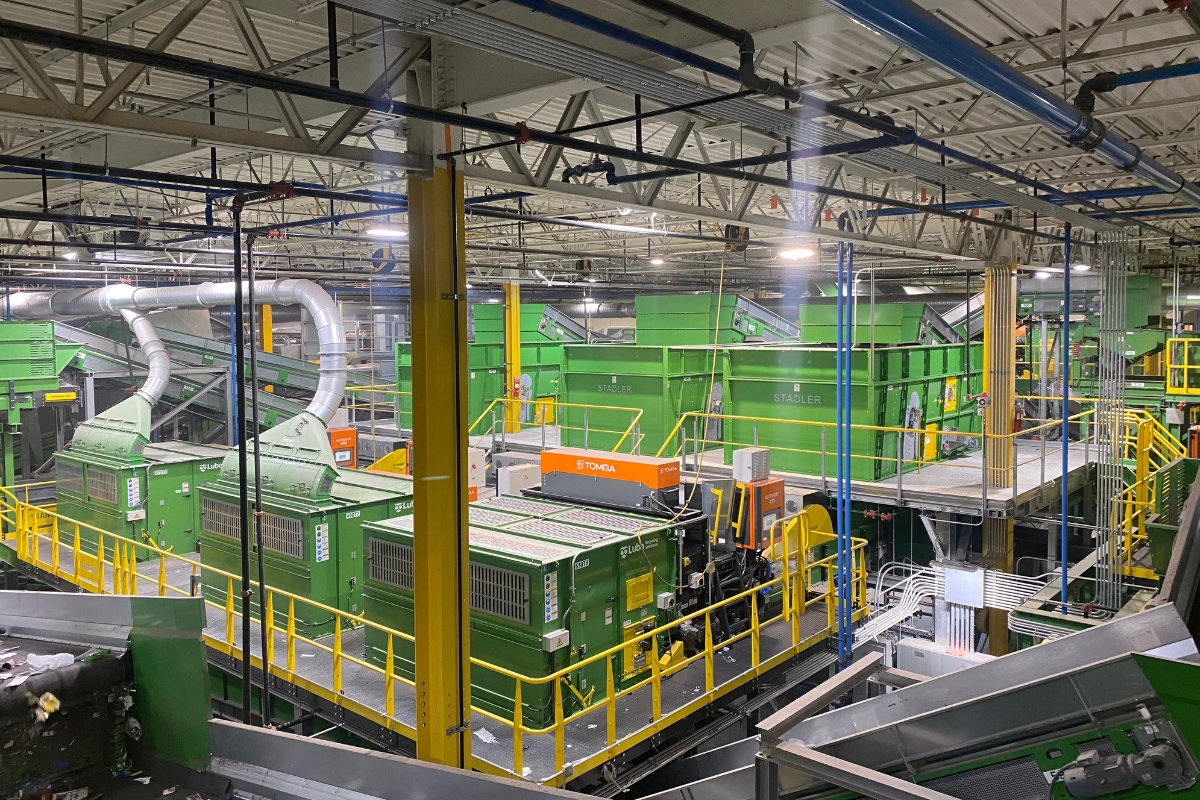
The recent upgrade of WM’s Germantown MRF in Wisconsin added 20% more capacity to one of the company’s largest facilities in the heart of a rapidly growing manufacturing corridor. | Courtesy of WM

With a nearly $39 million upgrade completed at one of its biggest MRFs, WM officials are looking to further refine automation capabilities as well as add volumes in the Midwest.

Although optical sorters are extremely sophisticated, WM has seen an uptick in textiles come through the sorting lines. 

“One item on our to-do list is to improve the differentiation between PET and polyester (fabric),” said Frank Fello, area vice president of the Upper Midwest, in an interview during a recent Resource Recycling tour of the MRF.

Some buyers have told Resource Recycling that PET bottle bale yields are lower from any automated plant, containing only 50-55% PET versus the industry standard of 60%. However, several sellers including WM have said they do not see a decrease in quality in the final bale contents.

One difference Fello has seen since relocating to southeastern Wisconsin is the level of community buy-in.

When he worked in the Great Lakes region of WM that includes Michigan, Indiana and Ohio, the contamination rate of collected volumes was around 18-20%. In comparison, in Wisconsin the rate is much lower at around 12%, he said.

“People here want to recycle,” he said. “Sometimes that can be an uphill push.”

In Germantown, paper and OCC constitute about 60-65% of volumes processed there, as is typical for MRFs, according to John Schultz, recycling facility manager at Germantown, who led the tour.

Brent Bell, vice president of recycling for WM, said in a later interview that much of the Wisconsin facility’s baled material remains local, with “a lot of really great, strong recycled paper mills” nearby. 

Packaging manufacturer Uline is headquartered in Pleasant Prairie, Wisconsin, about 50 miles from the MRF, and has two 1-million-square-foot warehouses that supply its regional distribution centers.

Uline offers paper and plastic bags and boxes containing varying amounts of post-consumer fiber and resin, according to the company website.

Plastics compounder Rehrig Pacific has a manufacturing plant in Pleasant Prairie as well, and corrugated box maker Smurfit Westrock also is building a plant there, though how much recycled content the facility may use hasn’t been made public. In addition, Green Bay Packaging recently broke ground on a plant expansion in Germantown. 

“Our focus is on making sure we have good end markets, because we don’t have a lot of room to store material,” said Bell. “We’re working on doing a better job of storytelling, investing in recycled paper mills that can only take cardboard boxes, not trees or woodchips, so that supply chain is very important.” 

While the Germantown plant was shuttered, most waste volumes were diverted to the company’s Chicago facility about 120 miles away, Bell said.

“Chicago was able to handle it, and that provided a nice relief valve,” Bell said. “Now that Germantown is back up, Chicago is looking for more volumes.”

Additional volumes could come from third-party haulers that may not have their own processing capabilities, he said. 

“Third-party haulers are big customers of our MRFs – counties, competitors and so on,” Bell said.

During MRF upgrades, WM works to ensure that recycling volumes stay out of landfills, he said. Nevertheless, WM executives cited factors including downtime at four of its recycling facilities for a 3% decrease in overall volumes collected in 2022. 

“We’ll always have a plan B in place to make sure those volumes are processed. They may need to be trucked further than we’d like, but we definitely want to keep those curbside programs in place,” he said.

Beyond Wisconsin

WM looks to future needs when upgrading its facilities, Bell said. 

“All of our facilities have extra capacity by design,” he said. “We’re building them for the next 10-15 years, so capacity is really high. So even though the Germantown plant is one of the largest, it’s not running at full capacity. As volumes in communities grow, we can continue to serve without any disruption.”

Between 2022 and 2026, WM will upgrade or build 40 facilities and add 2.8 million tons of capacity. But the company will continue to invest beyond 2026 as well, Bell said. 

Pittsburgh, Atlanta and Germantown were the first three retrofits completed this year, Bell said, while more are underway in Philadelphia; Sacramento, California; and Elkridge, Maryland.

Of the 13 facilities slated for work in 2024, two will serve areas where WM is not currently active – Fort Walton, Fla., and Portland, Ore. 

The Fort Walton facility will service the Panhandle region, Bell said. “No one processes in that area right now,” he said. “It’s definitely a new market, and right now the tons are going further out to be processed or not at all.”

Because the recycling stream continues to evolve, WM chose equipment that could keep up with those changes.

“We want to be able to program those changes into the optical sorters,” Bell said. “Having technology we can adjust in a very short amount of time will be very helpful in the future.”

A handful of very large facilities including Germantown have 230,000 tons of annual capacity, while locations including the upcoming Fort Walton site are on the smaller end of the scale, Bell said. The Germantown upgrade added 20% more capacity.

The size of the facility is the biggest factor in deciding what equipment will be installed. WM employs a combination of off-the-shelf equipment and bespoke machinery, using components from various vendors, he said. The upgraded Chicago MRF – whose design WM patented – provided a blueprint for full automation at future WM facilities, with the company showing its engineers the features they liked from each component. 

“We’ve built that design again, in Seattle and in Elkridge, Maryland,” Bell said.

The Portland MRF is expected to start up by the end of 2024. Public comments are due by July 26, and Bell said he didn’t see anything that could potentially change based on public comments. 

“Hopefully they are all positive, and it’s clearly needed capacity,” he said. “Hopefully we’re welcome.”

Fires: Ever-present danger

Since reopening in February, the Germantown MRF has experienced seven small fires, according to Fello. As with many fires at recycling facilities, improper battery disposal is often to blame. 

“It used to be pool chemicals and hot coals that started the fires,” Fello said, adding that fires take place throughout the supply chain, from collection trucks to the tipping floor to the machinery. 

Those hazards still exist, but household batteries including lithium-ion versions are an ever-growing problem, he said. 

As advanced as automation has become, it cannot yet detect batteries. “Give the optical sorting companies a few years to start utilizing AI to get that capability, but we’re not there yet,” Schultz added.  

A version of this story appeared in Resource Recycling on July 23.
Tags: Industry GroupsMRFs
TweetShare
Antoinette Smith

Antoinette Smith

Antoinette Smith has been at Resource Recycling Inc., since June 2024, after several years of covering commodity plastics and supply chains, with a special focus on economic impacts. She can be contacted at [email protected].

Related Posts

Recycling Partnership CEO stepping down

byStefanie Valentic
April 15, 2026

Outgoing CEO Keefe Harrison will remain until August with the organization she built from the ground up.

NERC launches hub to promote PCR demand 

byAntoinette Smith
April 15, 2026

The Northeast Recycling Council's PCR Material Demand Hub offers resources for government procurement, material- and product-specific resources, and certification and...

Reverse Logistics Network launches to support industry

byPaul Lane
April 14, 2026

The reverse logistics community has a new organization to give companies in that sector a place to connect.

Colorado regulators suggest mid-range EPR scenario

Why collaboration on plastic waste still matters

byCrystal Bayliss
April 13, 2026

Six years ago, the U.S. Plastics Pact launched at a moment of rising concern about plastic waste and growing momentum...

Industrial sources drive rise in PVC recycling

byAntoinette Smith
April 13, 2026

Volumes of post-industrial PVC recycled in 2024 rose by 10% from 2019 levels, while post-consumer sources fell and missed a...

WM opens new $60m MRF in Indy

byAntoinette Smith
April 10, 2026

The newest recycling facility has annual capacity of 200,000 tons and will send all mixed paper to Pratt Industries for...

Load More
Next Post

Eureka upgrades to tackle increase in small plastics

Leading the Charge in Safe Battery Recycling
Sponsored

Leading the Charge in Safe Battery Recycling

byThe Battery Network
April 13, 2026

We’re connecting people, brands, and communities through one nationwide network built to make battery recycling safer, simpler, and more accessible...

Read moreDetails

More Posts

Policy Now | December 2025 – Year-end nears, policy talks continue

Policy Now | December 2025 – Year-end nears, policy talks continue

December 1, 2025

Quebec PRO reflects on first year of packaging EPR

March 30, 2026

Certification scorecard – Week of March 23, 2026

March 24, 2026
Bottle cap design: No need to ‘reinvent the wheel’

Bottle cap design: No need to ‘reinvent the wheel’

June 25, 2025
MRF equipment firm Machinex wins patent fight with rival

Judge blocks four groups from joining Oregon Recycling Act injunction

April 7, 2026

Diversion Dynamics: Secondhand exports slow down fast fashion

March 5, 2026
Basel e-scrap rules disrupt larger metal sector

Basel e-scrap rules disrupt larger metal sector

June 26, 2025

Here’s what is (and isn’t) becoming law in California

October 16, 2019

Full plastic bag ban passes California Senate

June 4, 2024
Aduro losses nearly double on year

Aduro losses nearly double on year

April 15, 2026
Load More

About & Publications

About Us

Staff

Archive

Magazine

Work With Us

Advertise
Jobs
Contact
Terms and Privacy

Newsletter

Get the latest recycling news and analysis delivered to your inbox every week. Stay ahead on industry trends, policy updates, and insights from programs, processors, and innovators.

Subscribe

Welcome Back!

Login to your account below

Forgotten Password?

Retrieve your password

Please enter your username or email address to reset your password.

Log In

Add New Playlist

No Result
View All Result
  • The Latest
  • Analysis
  • Recycling
  • E-Scrap
  • Plastics
  • Policy Now
  • Conferences
    • E-Scrap Conference
    • Plastics Recycling Conference
    • Resource Recycling Conference
    • Textiles Recovery Summit
  • Magazine
  • About Us
  • Advertise
  • Archive
  • Jobs
  • Staff
Subscribe
This website uses cookies. By continuing to use this website you are giving consent to cookies being used. Visit our Privacy and Cookie Policy.