





Resource Recycling
  • The Latest
  • Analysis
    • All
    • Certification Scorecard
    • Industry Announcements
    • Opinion
    Apple Watch on product box.

    Wearables are coming and ITAD isn’t ready

    Certification Scorecard — Week of April 13, 2026

    EV Battery Pack - Sergii Chernov-Shutterstock

    Redwood, Rivian deal fuels US infrastructure plans

    Bloom ESG and e-Stewards roll out critical metals metric

    Colorado regulators suggest mid-range EPR scenario

    Why collaboration on plastic waste still matters

    Battery recycler Ascend Elements files for bankruptcy

    Battery recycler Ascend Elements files for bankruptcy

    EPR fees are a market signal. Here’s what they’re telling you.

    EPR fees are a market signal. Here’s what they’re telling you.

    Wolframite ore, the primary ore of tungsten from Altai, Russia

    Tungsten scrap export controls draw industry attention

    Certification Scorecard — Week of April 6, 2026

  • Conferences
  • Publications

    Other Topics

    Textiles
    Organics
    Packaging
    Glass
    Brand Owners

    Metals
    Technology
    Research
    Markets
    Grant Watch

    All Topics

Subscribe
No Result
View All Result
Resource Recycling
  • The Latest
  • Analysis
    • All
    • Certification Scorecard
    • Industry Announcements
    • Opinion
    Apple Watch on product box.

    Wearables are coming and ITAD isn’t ready

    Certification Scorecard — Week of April 13, 2026

    EV Battery Pack - Sergii Chernov-Shutterstock

    Redwood, Rivian deal fuels US infrastructure plans

    Bloom ESG and e-Stewards roll out critical metals metric

    Colorado regulators suggest mid-range EPR scenario

    Why collaboration on plastic waste still matters

    Battery recycler Ascend Elements files for bankruptcy

    Battery recycler Ascend Elements files for bankruptcy

    EPR fees are a market signal. Here’s what they’re telling you.

    EPR fees are a market signal. Here’s what they’re telling you.

    Wolframite ore, the primary ore of tungsten from Altai, Russia

    Tungsten scrap export controls draw industry attention

    Certification Scorecard — Week of April 6, 2026

  • Conferences
  • Publications

    Other Topics

    Textiles
    Organics
    Packaging
    Glass
    Brand Owners

    Metals
    Technology
    Research
    Markets
    Grant Watch

    All Topics

Subscribe
No Result
View All Result
Resource Recycling
No Result
View All Result
Home E-Scrap

Study: Canada’s e-scrap levels tripled over 20 years

Marissa HeffernanbyMarissa Heffernan
May 17, 2023
in E-Scrap
Study: Canada’s e-scrap levels tripled over 20 years

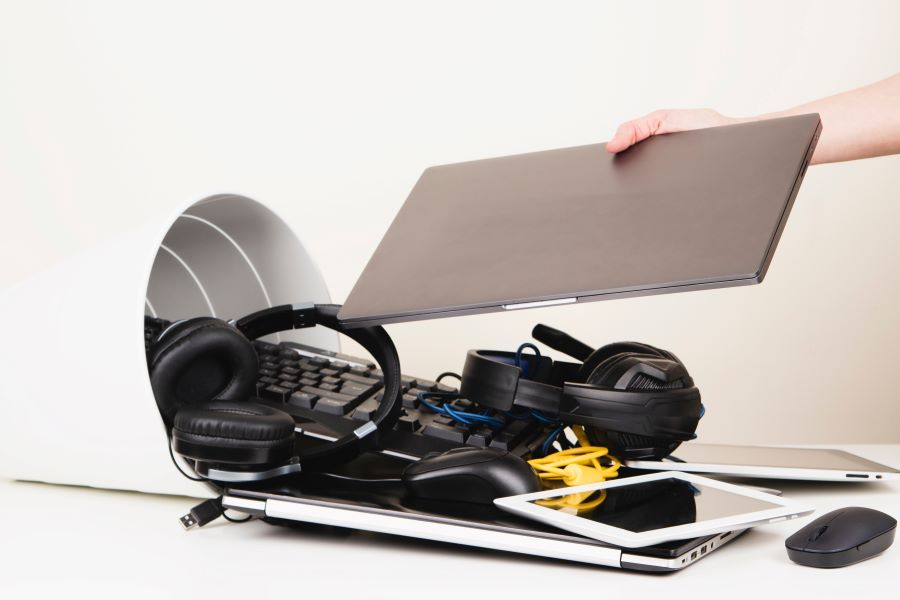
A comprehensive study of Canadian e-scrap generation found that the amount has more than tripled over the last two decades and is on track for even more growth in the coming years.

Researchers at the University of Waterloo said the study, which is one of the most recent and far-reaching, should help policymakers address the problem. They suggested improving repair, refurbishment and product life extension opportunities along with improving recycling and material recovery.

Lead author Komal Habib, a professor in the School of Environment, Enterprise and Development, said in a university press release that the study “provides useful insights to policymakers for setting up targets for e-waste reduction and recycling to recover valuable resources from e-waste.”

“E-waste could also help to create a secondary supply chain of critical materials, reducing the risks of potential supply disruptions,” Habib added.

Research details

The study was published in the Journal of Hazardous Materials. It looked at 51 product categories with 198 product types from 1971 to 2030, including white goods.

The researchers estimated that across that 60-year period, the total mass of e-scrap generated would be 42.3 million metric tons (about 46.2 million short tons), with an annual average growth rate of approximately 0.5%.

Per capita, generation increased from 18.3 pounds in 2000 to 55.8 pounds in 2020. It’s estimated to hit 69.4 pounds per capita by 2030.

“Over the last two decades, human society has moved towards a drastic digitization with the help of revolutionary technological advancements, transitioning industries towards automation while also escalating the possibilities of living in online worlds,” the study noted. “This transition has been a result of the ever-increasing use of electrical and electronic equipment (EEE), making them a blessing as well as a curse.”

Recent rapid advancement has also led to significantly shorter device lifespans, the study noted, and Canada does not have national legislation for e-scrap management. All but one of its provinces and territories do have regulations and industry-managed programs.
Canada’s population has steadily increased as well, which also contributes to the rising mass of e-scrap, the press release noted.

Per capita, e-scrap generation in Canada increased from 18.3 pounds in 2000 to 55.8 pounds in 2020.

The study found that large household appliances make up the largest segment of the total e-scrap by mass, but by quantity, household lighting was the most frequent item, followed by toys and sports equipment and information technology and telecommunications equipment.

“There are pros and cons of the expected increase in e-waste for the recycling industry,” the press release noted. “When it comes to IT and telecommunication equipment, the industry’s efforts to make lightweight products are leading to the dilution of precious and critical materials per product, creating a challenge for recyclers to recover. However, increasing quantities of this e-waste could lead to potential incentives for the continuous operation of the recycling industries.”

The researchers said a future study assessing consumer behavior data is necessary to create better sustainable management practices.


 

Tags: CanadaResearch
TweetShare
Marissa Heffernan

Marissa Heffernan

Marissa Heffernan worked at Resource Recycling from January 2022 through June 2025, first as staff reporter and then as associate editor. Marissa Heffernan started working for Resource Recycling in January 2022 after spending several years as a reporter at a daily newspaper in Southwest Washington. After developing a special focus on recycling policy, they were also the editor of the monthly newsletter Policy Now.

Related Posts

Aduro losses nearly double on year

Aduro losses nearly double on year

byAntoinette Smith
April 15, 2026

Amid rising expenses for R&D, hiring and scaling efforts, nine-month YTD losses were CAD $14.416 million compared to a loss...

Amazon, DOE partner on critical materials recovery

byScott Snowden
April 13, 2026

DOE and Amazon will study recovery of graphite from textiles and gallium from IT hardware, aiming to strengthen US supply...

Rice researchers use lemon juice to boost battery recycling

byScott Snowden
April 9, 2026

Rice researchers reported a battery recycling process that uses plasma and mild solvents to recover most metals from black mass...

Packaging sector sees shift from AI pilots to wider use

byScott Snowden
April 1, 2026

AI adoption is expanding across packaging operations as costs fall and use cases widen, though concerns around accountability, ROI and...

Quebec PRO reflects on first year of packaging EPR

byAntoinette Smith
March 30, 2026

The province's all-packaging collection approach has simplified messaging while providing lessons for the PRO as well as for industry.

Report pegs fire losses at $2.5b in US and Canada recycling industry

byScott Snowden
March 27, 2026

A new fire report estimates $2.5b in damage across US and Canadian recycling facilities in 2025, with lithium-ion batteries still...

Load More
Next Post
Recycled-content certification for electronics launches

Recycled-content certification for electronics launches

Leading the Charge in Safe Battery Recycling
Sponsored

Leading the Charge in Safe Battery Recycling

byThe Battery Network
April 13, 2026

We’re connecting people, brands, and communities through one nationwide network built to make battery recycling safer, simpler, and more accessible...

Read moreDetails

More Posts

Battery recycler Ascend Elements files for bankruptcy

Battery recycler Ascend Elements files for bankruptcy

April 13, 2026
EPR fees are a market signal. Here’s what they’re telling you.

EPR fees are a market signal. Here’s what they’re telling you.

April 10, 2026

Bloom ESG and e-Stewards roll out critical metals metric

April 15, 2026

Recycling Partnership CEO stepping down

April 15, 2026

AI surge, dealmaking reshape  ITAD industry 

April 16, 2026
Apple Watch on product box.

Wearables are coming and ITAD isn’t ready

April 16, 2026

Oregon’s battery EPR bill officially charged for implementation

April 10, 2026
Bill to update New Jersey e-scrap program heads to governor

New Jersey recyclers talk EPR

April 9, 2026
Industry group: Help us find the plastic bale volumes we need

PET bales sink further as other grades firm 

April 15, 2026

COM2 joins TERRA network as solar recycling expands 

April 17, 2026
Load More

About & Publications

About Us

Staff

Archive

Magazine

Work With Us

Advertise
Jobs
Contact
Terms and Privacy

Newsletter

Get the latest recycling news and analysis delivered to your inbox every week. Stay ahead on industry trends, policy updates, and insights from programs, processors, and innovators.

Subscribe

Welcome Back!

Login to your account below

Forgotten Password?

Retrieve your password

Please enter your username or email address to reset your password.

Log In

Add New Playlist

No Result
View All Result
  • The Latest
  • Analysis
  • Recycling
  • E-Scrap
  • Plastics
  • Policy Now
  • Conferences
    • E-Scrap Conference
    • Plastics Recycling Conference
    • Resource Recycling Conference
    • Textiles Recovery Summit
  • Magazine
  • About Us
  • Advertise
  • Archive
  • Jobs
  • Staff
Subscribe
This website uses cookies. By continuing to use this website you are giving consent to cookies being used. Visit our Privacy and Cookie Policy.