





Streaming media and text messages may be lucrative advertising platforms for companies selling products, but they’re also cost-effective channels for disseminating local recycling program information to targeted audiences.
A webinar from the Carolina Recycling Association (CRA) featured local program educators who shared their experiences reaching out to residents on the relative cheap through social media, mass texting and good old-fashioned container tagging. The tips could prove helpful to other program managers who want to increase capture rates and decrease contamination but don’t have millions of dollars in city coffers for communicating with the public.
“You can do a lot with what I feel like is a small investment as far as education and outreach goes,” said Elizabeth Morgan, environmental education specialist with the city of Rock Hill, S.C., which has been using mass text messaging to convey recycling tips and updates.
Moderated by Shannon Culpepper, recycling and education specialist at Chatham County, N.C., the May 4 webinar, titled “Educators Strike Back,” was Star Wars themed in honor of Star Wars Day, May 4 (“May the fourth be with you” is a popular pun based on the oft-repeated Star Wars line “May the force be with you”). About three-quarters of the viewers indicated they worked for local governments.
Advertising on streaming services
Shelby Lewis, recycling coordinator for the city of Tampa, Fla. and Edgar Castro Tello, recycling specialist at the city, discussed their work advertising through online streaming services. It was a strategy that 0% of the webinar listeners indicated they employed.
They created ads for video streaming sites YouTube and Hulu and audio-streaming sites Spotify and Pandora. Castro Tello noted that they produced the video in house. “We are actors, we are writers, we are directors, and we have fun with it,” he said.
The ads emphasize the global impacts of recycling and refer people to the city’s website to learn more about what’s accepted in the recycling program; later, when the city launched a recycling app, they altered the ad to direct residents to download the app. They also produced a video in Spanish, so that if someone has their YouTube or Hulu set up for Spanish, they’ll automatically receive the ad in that language, he noted. According to Census Bureau data, about one-fifth of Tampa residents speak Spanish at home.
Not everything went without a hitch. YouTube’s software multiple times flagged the video as political and sexual content, forcing them to refute the classification and get a YouTube employee to override the flag, he said. “It was a learning experience,” he said.The YouTube advertising ran for 45 days, and the ad fully played through 80,000 times, Lewis said, with a total cost was just under $1,100. It generated 445 website visits.
Hulu ad played 53,977 times over 31 days.
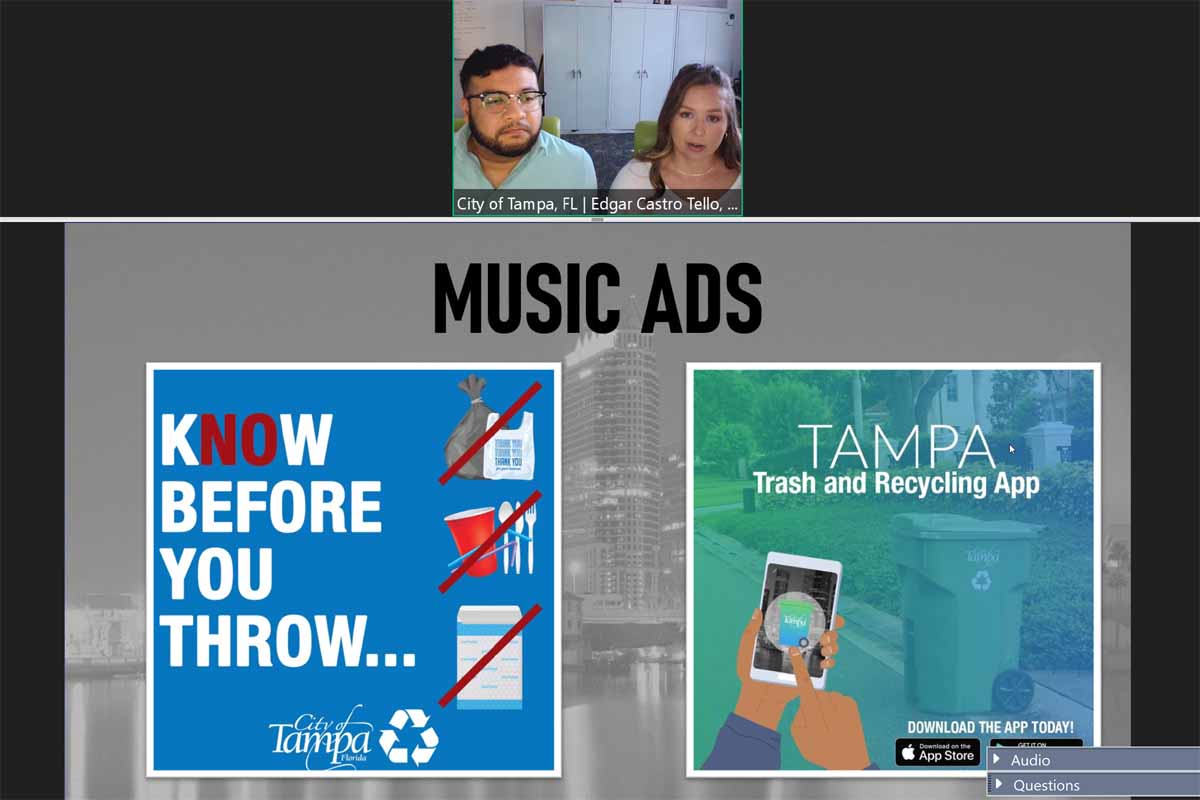
Lewis said the music-streaming services included both audio and graphics that popped up on the mobile device, allowing the listener to click to access more information. Because the graphic appears on a small phone screen, the Tampa staff used very large text, she said.
The ads emphasize that the program’s accepted-materials list has changed, and residents should check annually to see what’s allowed in their receptacles. After the messaging, music plays for a while. That’s important to give listeners time to unlock the phone and find and click on the ad, she said.
Learn more in person
Hear the latest tools and best practices on resident engagement from program leaders representing cities across North America at the 2022 Resource Recycling Conference in August in Austin, Texas. See full details on the session lineup and sign up at the early-bird rate today!Tampa had a budget of around $1,900 for each ad on Pandora and Spotify, Lewis said. Over 31 days, the Pandora ad reached 72,164 individual listeners, and it played an average of 2.5 times for each listener, Lewis said. The ad generated 823 clicks bringing listeners to the city’s recycling webpage. The Spotify ad also ran over 31 days. It reached 76,174 individual listeners, playing an average of 1.38 times for each. It generated 208 clicks to the city’s website.
“Streaming like this is reaching a part of the population that normally doesn’t receive bill inserts or printed media,” Castro Tello noted.
Mass texting approaches
Morgan of Rock Hill, S.C. said her city used cart tags, cart stickers, flyers, brochures, direct mailers and Pandora, TV and newspaper advertising. Rock Hill has about 75,000 residents.
But a solid waste reduction and recycling grant from the South Carolina Department of Health and Environmental Control helped the city launch text messaging as a strategy to reach residents. The city already had certain advantages, she noted: It provides utilities for residents, including sanitation service, and already has a text messaging system to inform residents about service outages or road work, she said.
For recycling information Rock Hill utilized the roughly 13,000 phone numbers already in the system, she said, and when customers sign up for utility accounts, they are given the option to opt-out of receiving texts.
“Because it’s informational and not a solicitation, we can automatically add them into text messaging and make it more of an opt out,” she said.
“We just thought we’d have more success if we started with 13,000 numbers than if we started with zero,” she added.
The city contracts with a company called TextPower to provide the service. Morgan said each text is limited to 160 characters, but the city can exceed that – and she typically does – resulting in a charge for two messages to each phone number.
She provided a few recommendations: Talk with the customer service department before sending a message because it will trigger increased call volume. That is a scenario the city particularly wants to avoid on days when city crews are shutting off power or water service for an area, resulting in higher call volumes anyway.
Some department heads have expressed interest in piggybacking on the system to add other messages, such as info on leaf collection, Morgan said, but she recommends keeping messages short and to the point to keep readers’ attention.
When customers reply to the text, the reply is sent to Morgan’s email inbox. She recommends cities don’t reply through that channel, however, lest customers request work orders through texting instead of through the established online or call-in request system.
In terms of cost, Rock Hill spent about $1,000 to send messages to about 13,000 phone numbers with information on recycling around Thanksgiving last year. Because the message exceeded 160 characters, it was billed as a double message. The costs came out to about 8 cents per phone number.
A town’s bin-tagging success
Allison Harvey, town administrator for the small jurisdiction of Clover, S.C., population 6,700, said her town is able to provide curbside collection for all single-family houses and some businesses through an 2005 agreement with York County. Through the arrangement, Clover pays half the salary, operating and equipment costs for collection, and recyclables are delivered to a York County facility for sorting and marketing. York County also operates three drop-off facilities near town.
Her town faces particular challenges given its fast population growth. Between the 2010 and 2020 censuses, the population grew 31%. The city educates citizens on recycling through its websites, social media and flyers – when new water service customers sign up, they also receive recycling info.
They’ve been “somewhat” effective, she said, but less so when educating residents on program changes. For example, in 2016, the city had to stop accepting glass, and in 2019, the city stopped accepting grocery stores bags and shredded paper. The city saw a lot of contamination after implementing the changes.
“We knew that we needed to do something else. We needed to try something more,” she said.
With the help of a CRA grant, Clover last year began conducting outreach on what is and isn’t accepted through postcards. The money also helped the town buy “oops” bin tags informing households that their recycling receptacle wasn’t emptied because of contamination.
The tagging required getting buy-in from the town’s lone collector, because it slows him down, she said. “So it has been a lot more intensive work for him, but it’s working,” she said. Clover has seen increased participation and less contamination in the blue bins.
“I do think that Yoda would be proud that not only did we try, but we did,” Harvey said.